

Waking up after a tarantula dream can leave you unsettled, curious, or oddly calm. The tarantula dream meaning rarely points to literal danger. More often, it’s fear you haven’t quite faced yet, or patience you’re being asked to learn, or a boundary somewhere that needs shoring up. Tarantulas don’t rush.
They sit, they watch, and that slow, deliberate presence is basically the whole key to reading the symbol. This guide walks through what a tarantula dream means by scenario, color, emotion, and spiritual tradition, so you can figure out what your subconscious mind is actually trying to hand you..
Quick Answer
A tarantula in a dream usually symbolizes fear, hidden pressure, patience, or a boundary being tested, not literal danger. A calm tarantula often reflects self control or quiet strength, while an aggressive one points to stress, avoidance, or an unresolved conflict. The exact tarantula dream meaning depends on what the spider did, how you reacted, and what’s happening in your waking life right now.
What Does It Mean to Dream About a Tarantula?
Dreaming about a tarantula generally represents a fear, pressure, or emotional situation that feels large, patient, and difficult to approach directly. It’s not a sudden scare so much as a presence that lingers. It watches. It waits. And honestly, that’s the whole point of the symbol.
Most dream researchers agree that the mind reaches for intense images, like a tarantula, when ordinary language can’t quite capture what you’re feeling. A vague sense of worry becomes a spider crouched in the corner of a room. Your subconscious mind is translating pressure into something you can actually picture, because “I feel stressed” doesn’t make for a very compelling dream.
What matters more than the tarantula itself is how you react to it. Fear usually signals unresolved anxiety. Calm tends to signal a kind of emotional maturity, even when the waking situation is still genuinely hard.
A few specific ways this shows up:
- Seeing a tarantula from a distance. Often early awareness of a problem you haven’t confronted yet. You know something’s there. It just hasn’t touched your daily life.
- A tarantula that ignores you. This can point to a fear that exists but hasn’t reached you directly, like layoffs happening at your company that haven’t hit your department.
- A tarantula on the wall or ceiling. Usually a looming issue you keep glancing at without addressing. Something you notice every single day and keep putting off.
Tarantula Dream Meaning by Scenario
The tarantula dream meaning changes significantly depending on whether the spider bites, chases, freezes, or simply appears and vanishes.
Tarantula Dream Meaning: Scenario Breakdown
| Scenario | Likely Meaning | Reflective Question |
| Tarantula bites you | A painful truth, betrayal, or sudden realization | What recent event still stings emotionally? |
| Tarantula chases you | Avoidance of a responsibility or difficult conversation | What are you currently running from? |
| You kill the tarantula | Confronting or suppressing a fear | Did you resolve it, or silence it? |
| Tarantula crawls on your body | Anxiety that has become personal or hard to ignore | Where do you feel your boundaries are being tested? |
| Many tarantulas appear | Overwhelm from multiple stressors | What several problems are competing for your attention? |
| Tarantula stays calm or still | Discipline, patience, or power held in reserve | Where would waiting serve you better than acting? |
| Tarantula in your house | Tension in your personal or family life | What unspoken issue is affecting your home life? |
| Tarantula disappears | Resolution, or a fear you’re not ready to face | Did the issue resolve, or did you look away? |
Treat these as starting points, not rules carved in stone. A tarantula that bites a lifelong arachnid keeper isn’t carrying the same emotional weight as one that bites someone with a genuine phobia.
What Does It Mean When a Tarantula Bites You in a Dream?
A tarantula bite in a dream usually symbolizes a boundary that has already been crossed, whether that’s a betrayal, a hurtful comment, or a consequence you’re bracing for. The bite is what shifts the dream from passive watching into something that actually lands.
Where the bite hits often shapes the meaning further:
- Bite on the hand. Tends to connect with work, responsibility, or something you recently agreed to take on, especially if it now feels heavier than you expected.
- Bite on the leg or foot. Often points to a decision or direction in life that’s being challenged, or just slowed way down.
- Multiple bites in one dream. Can reflect repeated emotional harm, the kind that comes from an ongoing conflict with a coworker or family member that keeps circling back.
- A bite that doesn’t hurt. Might suggest denial or emotional numbness. You’re aware something happened, you’re just not ready to sit with it yet.
What Does It Mean When a Tarantula Is Chasing You?
Being chased by a tarantula in a dream typically reflects avoidance, meaning there’s something in waking life, often a decision, conversation, or emotion, that you keep putting off. Funny enough, the size of the spider usually mirrors the size of the emotion, not the actual scale of the problem.
A few common variations:
- Chased through your own home. Usually ties avoidance to family life or a relationship you’ve been putting off addressing head on.
- Chased, and you manage to escape. Often brings real relief upon waking, and can reflect genuine readiness to confront the issue soon.
- Chased, and you freeze. Can point to feeling powerless against mounting pressure, like a financial situation that feels bigger than your ability to respond to it.
- Chased through an open, outdoor space. Tends to reflect external pressure, a deadline at work, say, or a public commitment you agreed to and now regret.
Anxiety has a way of blowing up a manageable problem until it feels impossible. A chasing tarantula dream is often the mind’s blunt way of asking you to finally look at what you’ve been avoiding.
Tarantula Color Meanings in Dreams
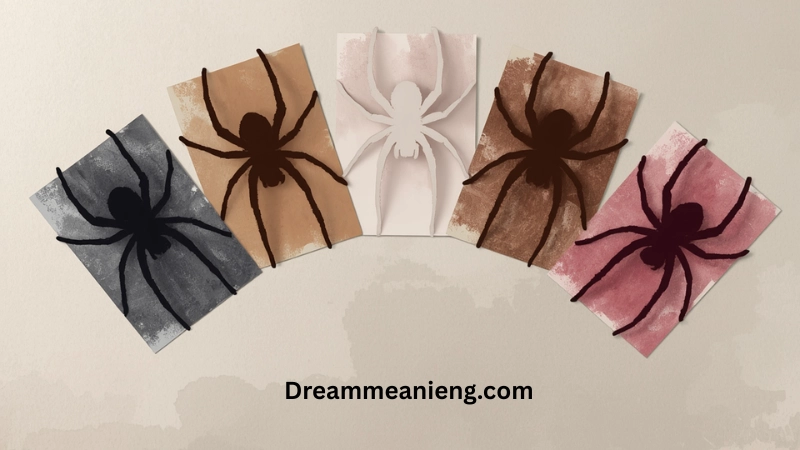
The color of a tarantula in a dream adds a specific emotional layer to the interpretation, shifting the tone from fear to caution, urgency, or even protection.
| Color | Symbolic Meaning |
| Black tarantula | The unknown, hidden emotion, or unprocessed grief |
| White tarantula | Purity behind a frightening exterior, often a spiritual test |
| Brown tarantula | Practical, real world worries such as finances or job stability |
| Red tarantula | Intense emotion, anger, or an urgent warning sign |
| Grey tarantula | Emotional neutrality, indecision, or a transitional phase |
Color rarely changes the core theme of fear or pressure underneath. What it does is adjust the tone, telling you whether the issue is emotional, spiritual, financial, or still a bit undefined.
Spiritual and Biblical Meaning of Tarantula Dreams
Spiritually, a tarantula dream is often read as an invitation to confront fear rather than a warning of danger, while biblically it connects to themes of fragile trust and the need to rely on faith over fear. Plenty of spiritual traditions treat spiders as symbols of creation and patience, since they build intricate webs out of nothing but themselves.
A tarantula, being bigger and more intense, tends to carry a heavier version of that lesson: face what unsettles you instead of bolting from it.
The Bible doesn’t mention tarantulas by name. Spiders more broadly get tied to fragile foundations or fleeting security, so a biblical reading usually centers on trusting God rather than human effort during uncertain seasons. This isn’t about punishment. It’s more a nudge toward spiritual alertness, a reminder to bring hidden anxieties into prayer instead of white knuckling through them alone.
A dream that feels calm or peaceful may point toward spiritual protection. One that feels aggressive or dark may suggest emotional blockage or a season of testing. Either way, reflection and prayer tend to serve you better here than fear or suspicion toward the people around you.
Cultural and Religious Interpretations Around the World
Tarantula and spider symbolism varies widely across cultures, ranging from creative and protective forces to warnings about deception, which is why context matters as much as the symbol itself.

Islamic dream interpretation often treats a tarantula as a symbol of hidden or deceptive influence rather than literal harm. These dreams are commonly read as a prompt to stay alert in relationships, and to turn toward dua and quiet reflection instead of suspicion.
Hindu dream symbolism frequently connects animals like tarantulas to karmic themes, past patterns resurfacing so they can finally be dealt with consciously. It’s less a warning, more an invitation toward self awareness.
West African folklore, particularly stories built around Anansi the spider, treats spiders as symbols of wisdom, cleverness, and storytelling rather than fear. Worth sitting with, honestly, since it flips the usual Western dream dictionary framing on its head, showing the same creature representing intelligence instead of dread.
Native American symbolism, especially the Spider Grandmother figure found in Hopi and Navajo tradition, connects spiders to creation, guidance, and the interconnected web of life. A tarantula through this lens can be wisdom arriving, not a threat closing in.
Modern Western psychology tends to strip the mythology away and focus on the clinical picture instead: phobia, stress response, unresolved anxiety. It’s the most common lens in mainstream dream interpretation today, but it’s only one piece of a much bigger cultural picture.
Psychological Meaning of Tarantula Dreams
From a psychological standpoint, a tarantula dream often reflects suppressed anxiety, an unresolved fear, or a power dynamic your conscious mind hasn’t fully processed. Carl Jung’s idea of the shadow self is a useful lens here.
In Jungian theory, the shadow holds the parts of ourselves we find uncomfortable or unacceptable, and dreams frequently personify that shadow as something frightening, a large spider, say, so it can finally be seen and acknowledged. A tarantula, read this way, is less an external threat and more an internal one asking to be noticed.
Freud’s earlier work took a different angle, often linking dream anxiety to repressed desires or tension left over from waking life, tension the conscious mind wasn’t ready to deal with head on.
There’s a more grounded, biological piece too. Arachnophobia is one of the most common phobias out there, and psychology researchers studying evolutionary threat detection have proposed that the human brain is simply wired to react strongly to spider like shapes regardless of actual danger. That wiring doesn’t switch off while you sleep, which is a big part of why tarantula imagery hits so much harder than more neutral dream symbols.
Sleep science backs this up further. According to sleep research published through the National Institute of Neurological Disorders and Stroke, dreams tend to be most vivid during REM sleep, and recent stress or unresolved emotion regularly bleeds into dream content. None of this means every tarantula dream is a hidden message waiting to be decoded, but it does support treating a vivid one as a real, meaningful mental event rather than random static.
Uncommon Tarantula Dream Scenarios
Less common tarantula dreams, such as one appearing in your car, your bed, or mid molt, carry meanings tied to control, intimacy, and personal transformation.
- A tarantula in your car. Vehicles in dreams often represent direction and control over your own path, so a tarantula here can reflect fear tied to a major life decision currently in motion, a career change, a move, something like that.
- A tarantula in your bed. The bed is tied closely to rest, privacy, and intimacy, so this one often points to an issue affecting a close relationship or your ability to actually relax.
- A tarantula on your face while sleeping. Genuinely unsettling, and it tends to reflect a feeling of being silenced or suffocated in some waking situation, holding back an opinion at work, say, or in a family conflict.
- A tarantula molting or shedding its skin. A biologically accurate symbol most sites skip entirely. Molting means real transformation, a sign you’re outgrowing an old version of yourself, or an old way of handling a problem.
How to Interpret Your Own Tarantula Dream
To interpret a tarantula dream accurately, focus on four things: the spider’s behavior, your emotional reaction, the setting, and what’s felt unresolved in waking life lately.
- Write the dream down immediately. Color, size, location, all of it fades within minutes of waking, so getting it down fast preserves the details that actually matter.
- Name the strongest emotion you felt. Fear, calm, disgust, curiosity, they all point toward different interpretations, and naming the emotion usually tells you more than naming the symbol does.
- Note the setting. A tarantula at work may connect to pressure or authority. One in a bedroom may relate to privacy, rest, or intimacy instead.
- Connect it to something recent. Scan the last few days for anything tense, hidden, or unresolved, since dream content tends to borrow heavily from recent experience.
- Ask what the dream might be nudging you toward. Setting a boundary, having a hard conversation, or just resting more, any of these could be a reasonable response depending on the dream.
- Pick one grounded next step. A good interpretation should leave you with more clarity, not more fear, so close the process out with something specific and doable.
Frequently Asked Questions
What does it mean when you dream about a tarantula? A tarantula dream usually represents fear, hidden pressure, or a boundary that needs attention rather than literal danger. The specific meaning depends on the spider’s behavior, your emotional response, and what feels unresolved in your waking life at the time.
Is dreaming about a tarantula a bad sign? Not necessarily. Most tarantula dreams reflect emotional processing rather than bad luck or a coming disaster. A calm tarantula can even represent patience or inner strength rather than a warning, meaning the dream is more likely mirroring your current stress level than predicting an actual threat.
What does it mean when a tarantula bites you in a dream? A bite typically symbolizes a boundary that has already been crossed, such as betrayal, a hurtful comment, or a consequence you sense is coming. The location of the bite on your body often adds personal meaning, since a bite on the hand can point to work stress while one on the leg may relate to a stalled decision.
What is the difference between a spider dream and a tarantula dream meaning? A general spider dream often centers on creativity, patience, or feeling entangled in a situation. A tarantula dream meaning tends to feel more intense and immediate, reflecting a fear or pressure that feels larger, closer, and harder to avoid, since the size and stillness of a tarantula tend to amplify whatever emotion is already present.
Why do I keep having recurring tarantula dreams? Recurring tarantula dreams often indicate that the same fear, conflict, or unresolved question keeps resurfacing because it hasn’t been fully addressed while awake. Tracking each dream’s setting, behavior, and outcome can reveal whether the underlying issue is easing, worsening, or simply changing shape over time.
What does a tarantula in your house mean spiritually? A tarantula inside the house often points to tension or hidden anxiety within your personal or family life. Spiritually, it is frequently read as an invitation to bring that tension into prayer, reflection, or honest conversation rather than letting it sit unspoken between the people you live with.
Can a tarantula dream predict something bad happening? Generally, no. Most dream researchers view tarantula dreams as a reflection of current emotions and stress rather than a prediction of future events. The dream is more useful as a mirror than a forecast, so it’s worth asking what it reveals about now rather than what it might mean for later.
Final Thoughts
A tarantula dream can feel intense the second you wake up, but the message underneath is almost never as frightening as the image itself. Most of the time, your mind is simply pointing at a fear, a boundary, or a pressure you’ve been carrying quietly and asking you to actually look at it.
So next time a tarantula shows up in your sleep, try pausing before you reach for panic. What did it do? How did you feel? And what in your waking life might be asking for that same attention? Seen this way, the tarantula dream meaning stops being about fear and starts pointing at the quiet strength you were probably carrying all along.