
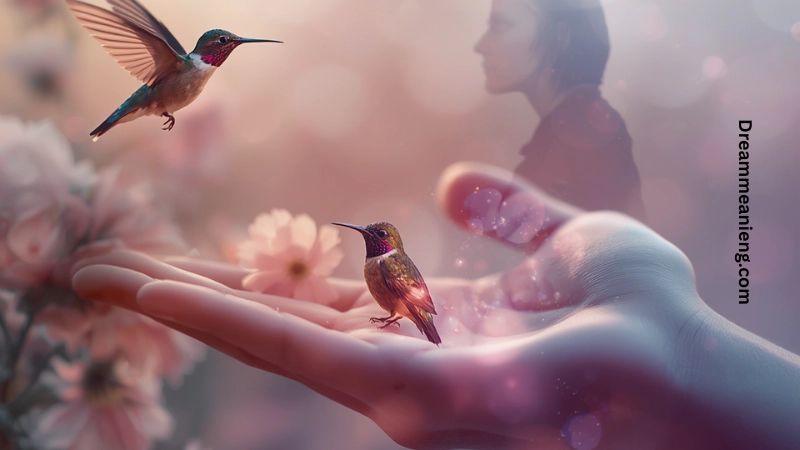
A hummingbird dream meaning usually centers on joy, resilience, and emotional renewal, but the exact message depends heavily on what the bird was doing. Maybe it hovered close to your face. Maybe it sat calmly in your palm, or turned up lifeless on the ground, which is a much heavier image to wake up from.
Each version points somewhere slightly different emotionally. Below, I’ll walk through the spiritual, cultural, biblical, and psychological readings of the most common hummingbird dream scenarios, so you can actually figure out what your subconscious might be nudging you toward.
Quick Answer
In most dream traditions, a hummingbird dream meaning points to joy, emotional healing, and finding lightness during a difficult season. A calm or approaching hummingbird often signals good news or reassurance, while a dead or trapped hummingbird usually reflects emotional exhaustion or blocked joy. Culturally, hummingbirds are linked to messengers, ancestors, and resilience. Psychologically, they often appear during periods of transition or emotional processing.
What Does It Mean When You Dream About a Hummingbird?
Dreaming about a hummingbird generally reflects emotional lightness, resilience, and a reminder to notice small sources of joy, though the specific meaning shifts based on the bird’s behavior in the dream.
There’s something almost poetic about the fact that such a tiny creature carries this much symbolic weight. Its heart beats hundreds of times a minute. Its wings blur into nothing. And yet it still stops, hovering dead still, at a single flower like it has all the time in the world. That contrast, frantic energy paired with sudden stillness, is a big part of why hummingbirds keep showing up in dreams tied to emotional healing.
Dream psychology has a theory for this, actually. Animals that appear briefly and vividly, the way hummingbirds tend to, are often thought to represent something the subconscious is trying to push to the surface fast, more like a flash of insight than a slow building storyline. So if you woke up from a hummingbird dream feeling weirdly comforted, or unexpectedly emotional for no clear reason, pay attention to that. Honestly, that gut reaction tells you more than the symbol itself usually does.
Context is everything here. A hummingbird that lingers calmly reads nothing like one that’s frantic, hurt, or trying to escape a room. Let’s get into how those differences actually change the interpretation.
Hummingbird Dream Meaning by Scenario
The meaning of a hummingbird dream changes significantly depending on the specific scenario, from a bird hovering near you to one that appears dead or trapped.
Here’s a quick reference table, and then a closer look at the scenarios people actually ask about most.
Table 1: Hummingbird Dream Scenarios and Their Meanings
| Dream Scenario | Core Meaning | Emotional Signal |
| Hummingbird flying freely | Freedom, momentum, pursuit of purpose | Optimism, forward motion |
| Hummingbird hovering near you | Indecision, reflection, a pause before a choice | Need for clarity |
| Hummingbird landing on your hand | Trust, spiritual connection, safety | Emotional openness |
| Hummingbird feeding | Self care, nurturing joy, small acts of kindness | Restoration |
| Multiple hummingbirds | Abundance, social harmony, connection | Gratitude |
| Dead or injured hummingbird | Blocked joy, emotional exhaustion, end of a cycle | Grief, fatigue |
| Hummingbird trapped indoors | Feeling restricted, too many obligations | Overwhelm, restlessness |
| Hummingbird chasing you | Anxiety about freedom or a relationship | Avoidance, tension |
| Hummingbird entering your house | Good news, positive emotional shift at home | Hope |
| Hummingbird nest or egg | New beginnings, something still forming | Anticipation |
What Does a Flying Hummingbird Mean in a Dream?
A flying hummingbird in a dream typically symbolizes freedom, forward momentum, and the pursuit of something meaningful you may have been putting off.
If the flight felt easy, unhurried, almost playful, that usually points to a sense of ease returning after a stretch of feeling stuck. But if it felt frantic or scattered, darting everywhere at once, that’s more often restlessness talking. You’re moving, sure. You just don’t have a clear destination yet, and some part of you knows it.
What Does It Mean If a Hummingbird Lands on You in a Dream?
A hummingbird landing on you in a dream usually represents trust, spiritual reassurance, and a quiet permission to feel safe again.
This one tends to show up after a period of guardedness. A breakup. A loss. A few too many weeks of low grade anxiety you couldn’t quite name. The bird choosing to land instead of staying distant mirrors something happening in you, a willingness to let something gentle back in, even if you’re not fully ready to admit it yet.
What Does a Dead Hummingbird in a Dream Mean?
A dead hummingbird in a dream often symbolizes blocked joy, emotional exhaustion, or the ending of a particular chapter in your life.
It’s an unsettling image, no question. But it’s rarely a literal warning, so try not to spiral. More often, it’s pointing at a part of you that’s just tapped out, creatively, emotionally, physically, and asking for rest instead of more output. Sometimes it’s simpler than that too. It can just mark the end of something that had already run its course anyway, a job, a relationship, a version of yourself you’ve outgrown. One reader who wrote about this dream had it the same week she left a job she’d outgrown years earlier, which is a pretty ordinary example of how the timing often lines up with something already ending in waking life.
The Spiritual Meaning of a Hummingbird Dream
Spiritually, a hummingbird dream meaning is often read as a message of hope, renewal, and a nudge to stay emotionally open even during hard seasons.
A lot of spiritual frameworks treat the hummingbird as a totem or spirit animal, basically a stand in for traits you already carry, or ones you’re being nudged to grow into. People who feel drawn to hummingbird symbolism tend to describe themselves as adaptable, emotionally tuned in, quick to bounce back after rough patches.
There’s also an old thread connecting hummingbirds to heart energy, the idea that they show up specifically when the heart needs to soften or crack back open a little. I’ll be upfront: this isn’t about literal cardiology. It’s more poetic shorthand, a way different traditions have of describing emotional receptivity without getting clinical about it.
Cultural, Biblical, and Psychological Interpretations of Hummingbird Dreams
Beyond general spirituality, hummingbird symbolism carries specific meaning across Native American tradition, Aztec mythology, Christian scripture, and modern dream psychology, each offering a different lens on the same dream.
Native American and Indigenous Symbolism
Native American traditions never settled on one fixed reading of the hummingbird, and honestly, that variation is the more interesting story than any single meaning would be. Beliefs shift by nation, by region, sometimes by the specific oral tradition a family carried forward. What stays fairly constant, though, is the idea of the bird as a go between, something that moves between worlds rather than belonging fully to one. Some groups tied that movement to rainfall and the health of crops. Others framed it as a carrier of prayer, something small enough to slip past the usual barriers between the human and the unseen.
That range matters more than any single data point. It’s less a fixed symbol and more a shared instinct across dozens of distinct cultures that something this small, this fast, must be doing more than just feeding.
Aztec and Mesoamerican Mythology
Mesoamerican tradition took the hummingbird somewhere darker and, honestly, more interesting than most modern spiritual sites give it credit for. Aztec belief tied the bird to Huitzilopochtli, a deity associated with both the sun and war, and to a fairly striking idea: that warriors who fell in battle didn’t simply die, they transformed, returning as hummingbirds so that courage never actually got lost, just relocated into something smaller and faster.
It’s a rougher, more martial reading than the gentle “messenger of joy” framing most sites lean on, and it’s worth sitting with, because it complicates the idea that hummingbird symbolism has always been soft.
Hummingbird Dream Meaning: What Does the Bible Say?
The Bible does not mention hummingbirds directly, but a hummingbird dream meaning is often interpreted through the broader biblical theme of God’s provision and care for small creatures.
This reading leans on passages where Jesus points to birds as proof of divine attentiveness, the idea being that even something small enough to overlook is still provided for, moment by moment, with no need to hoard resources for tomorrow. Applied to a dream, that can land as a quiet reminder that you’re not overlooked either, even in a season that feels small or uncertain right now.
For some people, this dream shows up exactly when faith feels thin. Less a dramatic sign, more a gentle tap on the shoulder toward trust.
Islamic and Other Dream Traditions
Hummingbirds do not appear in classical Islamic dream dictionaries, since the bird is native to the Americas and was never part of the regions where those texts were written. Within that broader tradition, a hummingbird would most likely fall under the general category of small, brightly colored birds, typically read as good news or an unexpected blessing rather than assigned any specific named meaning. I’d rather say that plainly than invent a precise interpretation the source material doesn’t actually support.
The Psychological Meaning Behind Hummingbird Dreams
From a psychological standpoint, a hummingbird dream often surfaces during periods of transition, when the mind is processing change and uses the bird’s lightness and speed as a symbol for emotional relief.
Carl Jung argued that animals in dreams frequently represent instinctual or emotional material the conscious mind hasn’t fully caught up with yet, something felt before it’s understood. A hummingbird fits that pattern almost too well. It rarely sticks around long enough to feel like a fully formed thought. It’s more like a flash of feeling, and honestly, that’s often exactly how real emotional breakthroughs happen. Not gradually. Suddenly, and a little disorienting.
Freud’s earlier framework took a different angle, treating animal imagery in dreams as a stand in for a specific desire or unresolved tension. Read through that lens, a hummingbird might represent a wish for lightness, or relief from something that currently feels heavy. Neither theory is claiming to be the final word here. They’re just two different ways of putting language to something dreams do naturally anyway, turning feeling into image.
What Do Different Hummingbird Colors Mean in a Dream?
The color of the hummingbird in your dream adds a layer of meaning on top of the core scenario, with each color tied to a different emotional theme.
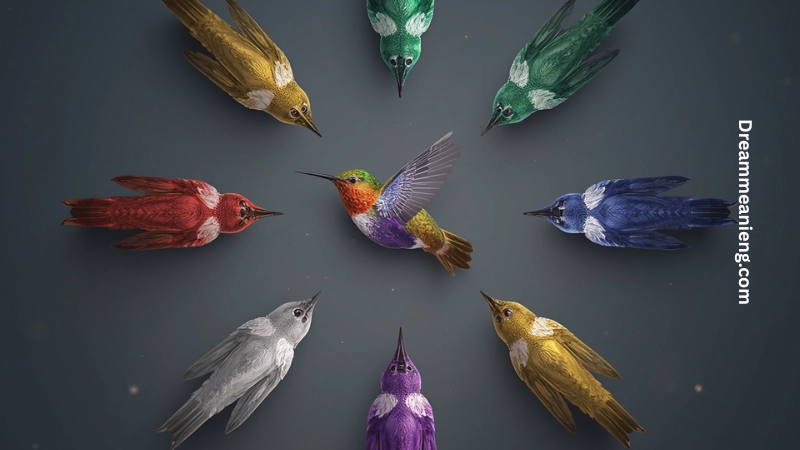
Quick caveat before the table: these associations come from general color psychology mixed with folk tradition. They’re not fixed rules carved into stone anywhere, so treat them as extra context, not a formula you have to force your dream into.
Table 2: Hummingbird Colors and Their Meaning in Dreams
| Color | Symbolic Meaning | Best Read In Context Of |
| Red | Passion, courage, urgency | Decisions, bold action |
| Green | Healing, growth, balance | Recovery periods |
| Blue | Calm, honesty, clear communication | Conflict resolution |
| Purple or violet | Intuition, spiritual reflection | Inner questioning |
| Yellow | Optimism, creativity, cheerfulness | Motivation dips |
| White | Purity, transition, rare significance | Major life change |
| Multicolored | Complexity, transformation | Periods of layered emotion |
A red hummingbird showing up during a genuinely stressful week might just be reinforcing that you need to act with some courage instead of waiting it out. A green one appearing while you’re recovering from an illness, or just a hard emotional stretch, is probably echoing a healing process that’s already underway, not announcing a new one.
Is Dreaming About a Hummingbird a Good or Bad Sign?
In most interpretations, a hummingbird dream meaning is a positive one, though a small number of scenarios point toward emotional fatigue or restlessness rather than good news.
Most hummingbird dreams, especially the ones involving flight, feeding, or a calm encounter, get read as encouraging, tied to joy and emotional renewal creeping back in after a hard stretch. That said, I don’t think every hummingbird dream deserves an automatic gold star.
A hummingbird that seems frantic, trapped, or unable to settle can be pointing at something less comfortable. Overcommitment. Avoidance of stillness. A quiet kind of burnout you haven’t quite named yet. None of this is meant to alarm you. It’s meant to be honest. A dream where the bird is struggling is usually less about doom and more about you needing to slow down before exhaustion actually catches up.
The most accurate read almost always blends the symbol with how the dream made you feel. Symbolism is a starting point. It’s not a verdict.
How to Interpret Your Own Hummingbird Dream
To interpret your own hummingbird dream accurately, look at three details, what the bird was doing, how you felt during the dream, and what is currently happening in your waking life.
Step 1: Note the bird’s behavior. Flying freely, hovering, feeding, injured, trapped? That sets your baseline scenario from the table above.
Step 2: Note your emotional response inside the dream. Calm, joyful, anxious, sad, they all point to different underlying themes, even when the visual is identical on paper.
Step 3: Connect it to something happening right now. Ask yourself what’s actually unfolding in your life at the moment, a transition, a loss, a decision you’ve been avoiding. Dreams rarely arrive out of nowhere, even when the connection isn’t obvious at first glance.
One practical tip: write the dream down as soon as you wake up, including the small, seemingly pointless details. That habit alone tends to make this kind of reflection far more accurate than trying to reconstruct it hours later, once the specifics have already blurred.
Frequently Asked Questions
What does it mean when you dream about a hummingbird? Dreaming about a hummingbird usually reflects joy, emotional healing, and resilience, though the specific meaning depends on the bird’s behavior in the dream. A calm hummingbird tends to signal reassurance, while a distressed one often points to emotional fatigue or an unmet need for rest.
Is dreaming about a hummingbird a good sign? Yes, in most cases. Hummingbird dreams are generally associated with positive emotional shifts, renewal, and hope, though a trapped or dead hummingbird can point to restlessness or exhaustion instead of good news.
What does it mean when a hummingbird visits you in a dream? A visiting hummingbird often represents reassurance or a gentle emotional check in, sometimes tied to a loved one, sometimes simply to your own need for comfort during a difficult or uncertain stretch of life.
What does a dead hummingbird in a dream symbolize? A dead hummingbird in a dream typically symbolizes blocked joy, emotional exhaustion, or the ending of a chapter in your life, rather than a literal warning. It often appears when rest is genuinely overdue.
Does dreaming about a hummingbird mean love is coming? In some interpretations, yes, hummingbirds are associated with affection and emotional connection. More broadly, though, they represent emotional openness, which can apply to any kind of relationship, not only romantic ones.
What does it mean if a hummingbird lands on you in a dream? A hummingbird landing on you in a dream generally represents trust, safety, and a willingness to let something gentle back into your life, often following a period of emotional guardedness or withdrawal.
Why do I keep having the same hummingbird dream? Recurring hummingbird dreams often point to an ongoing emotional theme your mind is still processing, commonly related to joy, adaptability, or an unresolved need for lightness in daily life.
What does a hummingbird mean spiritually after someone dies? Many people interpret a hummingbird sighting or dream after a loss as a comforting sign of continued connection, a belief rooted in several folk and spiritual traditions, though it remains a personal rather than universal interpretation.
Conclusion
A hummingbird dream meaning rarely comes down to one tidy answer, and honestly, I think that’s the point. Most of the time it’s pointing toward joy, resilience, a heart that’s finally ready to feel a bit lighter. But the details matter more than people expect. The bird’s behavior, its color, the emotion you woke up carrying, all of it shapes what the dream is actually trying to tell you.
If you take just one thing from all this, let it be this: trust your own emotional reaction to the dream at least as much as any symbolic meaning attached to it. Symbolism gives you language. You’re the one who actually felt it. So next time a hummingbird finds its way into your sleep, don’t reach for your phone right away. Sit with it a second. That small, bright visitor might just be asking you to notice something you’ve been too busy to feel.

Ayaan Shah is the founder of this website and a passionate dream analyst. He specializes in symbolic and psychological interpretations of dreams. With years of research in human behavior and subconscious mind, he aims to make dream meanings simple, clear, and accessible for everyone.


