

A dragonfly dream meaning usually centers on transformation, quick emotional clarity, and the sense that something in your life is shifting faster than you can name. Dragonflies move between water and air, between the hidden and the visible, which is why they tend to show up during periods of change.
The meaning shifts depending on what the dragonfly did, how it looked, and how you felt watching it. This guide covers every major scenario, color, and cultural reading, plus two angles most dream dictionaries skip: grief, and how this dream differs from a butterfly or moth dream.
Quick answer
Dreaming about a dragonfly usually points to transformation, adaptability, and emotional clarity, reflecting the insect’s own shift from water dwelling nymph to winged adult. A calm dragonfly that lands on you suggests readiness for change. A frantic, swarming, or dead dragonfly usually signals overwhelm, avoidance, or fatigue. Context, especially your emotional tone in the dream, changes the meaning more than the dragonfly itself.
What Does It Mean When You Dream About a Dragonfly?
A dragonfly dream most often reflects a period of personal transformation, where you’re being asked to move quickly and clearly between how you feel and how you think.
That’s the short version. Here’s the more grounded one: dragonflies start life underwater, hidden and slow, then emerge into open air as something almost unrecognizable. When your mind reaches for that image while you sleep, it’s often because some part of you is going through a similar shift moving from something private and half formed toward something visible and out in the open. Dragonfly dream meaning, in that sense, is less about the insect and more about timing.
The meaning isn’t fixed, though. It hinges on three things working together:
- What the dragonfly did landed, chased you, swarmed, died
- How you felt while it happened calm, afraid, delighted, unsettled
- Where you actually are in waking life a decision pending, a loss you’re still processing, a transition already underway
In the questions people tend to ask about this dream, one detail comes up again and again without them realizing it: insects are one of the least common categories in recorded dream content, according to long running dream research (the Hall and Van de Castle norms, still used as a baseline in sleep psychology today). That rarity is part of why a dragonfly tends to feel significant when it shows up. Your mind doesn’t usually reach for insects at random.
The Core Symbolism Behind Dragonfly Dreams
Every dragonfly dream draws on the same three symbolic roots: incomplete metamorphosis, the crossing between water and air, and iridescent illusion.
Once these three ideas click, every scenario later in this guide gets a lot easier to read. They’re the foundation everything else sits on.
Why the Dragonfly’s Life Cycle Matters in Dream Interpretation
Dragonflies belong to the insect order Odonata, and their life cycle is stranger than most people realize. Instead of the one dramatic transformation a butterfly goes through, a dragonfly nymph molts gradually anywhere from six to twelve times inching closer to its adult form with each shed exoskeleton.
No cocoon. No pause button. Just steady, visible change, one molt at a time, right up until the final emergence, when the winged adult climbs out of its own larval skin and takes flight within hours.
That matters for interpretation, because it points to a specific kind of dream message: not one big dramatic turning point, but a change that’s been unfolding in smaller stages you probably haven’t fully clocked yet.
Water, Air, and Emotional Clarity
The nymph stage plays out entirely underwater, and water is one of the oldest dream symbols going for the unconscious and for raw emotion. The adult stage happens in open air, which dream psychology tends to link to thought, perspective, and conscious awareness.
A dragonfly dream is often staging the exact movement from feeling something to understanding it. Throw in the dragonfly’s near 360 degree compound vision, and the dream might also be nudging you to look directly at something you’ve been sidestepping.
Common Dragonfly Dream Scenarios and What They Reveal
The dragonfly’s behavior in your dream whether it lands, chases, swarms, or dies changes the interpretation more than any other detail.

Below are the scenarios that come up most often, each with a specific, grounded reading instead of a one line guess.
Lands on you. This usually reads as a moment of readiness. Land on your hand, and the dream may be pointing toward an action you’re finally prepared to take. Land on your shoulder instead, and it can point toward a responsibility you’re ready to carry something you’ve been putting off owning.
Chase you, or you can’t catch it. This pattern often mirrors a goal or a truth that keeps moving just out of reach. Playful mood? Probably healthy curiosity without a clear finish line yet. Frantic mood? That’s more likely frustration or perfectionism chasing something you haven’t defined clearly enough to actually catch.
Appears dead or injured. This tends to surface during genuine burnout. Constant mental scanning, whether from overwork, multitasking, or emotional vigilance, is exhausting, and the dream may be using a heavy image to say so plainly. It’s rarely a literal warning. It’s closer to your mind flagging that the lightness has gone out of something.
Flies into your house or bedroom. Homes in dreams tend to represent your inner life or your closest relationships, so this one usually suggests change is arriving somewhere you assumed was settled in a routine, a role, or a private part of yourself you hadn’t expected to shift.
Table 1: Dragonfly Dream Scenarios at a Glance
| Scenario | Likely Meaning | Ask Yourself |
| Lands on your hand or shoulder | Readiness for clarity or a decision | What am I finally ready to act on? |
| Chases you or flees when approached | Avoidance or a shifting goal | What am I circling instead of confronting? |
| Swarm surrounds you | Too many signals at once, overwhelm | Which two things actually need my attention? |
| Dead or injured | Fatigue, stalled growth, burnout | Where do I need rest before I can change? |
| Enters your house | Change reaching your private life | What routine or role is being disrupted? |
| Bites you | Feedback that stings but clarifies | What honest input have I been resisting? |
| Giant dragonfly | An issue that has outgrown its size | Is this truly this large, or does it feel that way? |
| Speaks or seems to send a message | Intuition assembling a pattern | If it said one sentence, what would it be? |
Dragonfly Dream Meaning by Color
The color of the dragonfly in your dream adds emotional shading to the core meaning of transformation, rather than changing it entirely.
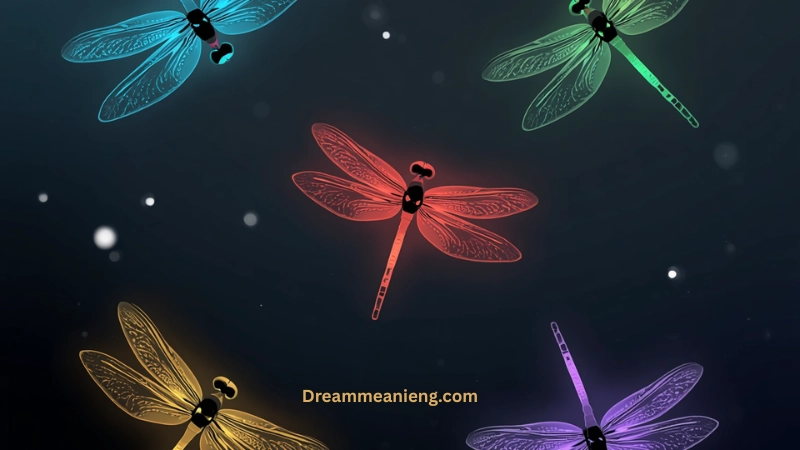
Think of color as a modifier, not its own separate symbol. It tells you something about the tone of the change, not a different kind of change altogether.
Table 2: Dragonfly Colors in Dreams
| Color | Emphasis |
| Blue | Calm, intuitive clarity, emotional truth arriving gently |
| Green | Healing, renewal, balance returning after a hard stretch |
| Red | Urgency, passion, a decision that can’t wait much longer |
| Black | Deeper, more private transformation, often unconscious work |
| White | Purity of insight, a clean and unclouded new start |
| Gold or yellow | Optimism, intellectual breakthrough, a reward for recent effort |
| Purple | Spiritual or intuitive insight, a shift in perspective rather than circumstance |
| Brown | Grounding, practical integration of a change already underway |
Read the color alongside the scenario from the table above, not in isolation. A red dragonfly that lands calmly reads very differently than a red dragonfly chasing you across a parking lot in your dream.
Cultural and Religious Interpretations of Dragonfly Dreams
Cultures read the dragonfly differently depending on whether it’s treated as a symbol of renewal or, in parts of Europe, as an omen worth being wary of. This is also where dragonfly dream meaning tends to diverge the most from one dictionary to the next, since so much of it depends on which tradition a writer defaults to.
What Is the Biblical Meaning of a Dragonfly in a Dream?
The Bible has no direct or symbolic reference to dragonflies that scholars point to. The insect lists in Leviticus and Deuteronomy are organized around ritual cleanliness rather than natural history, and dragonflies simply never come up in them.
So Christians who reflect on this dream tend to lean on broader scriptural themes instead water as cleansing, air and light connected to spirit, and the general biblical language of renewal and discernment. It’s a reasonable reading. Just know going in that it isn’t pulled from a specific verse.
What Does a Dragonfly Mean in Islamic Dream Interpretation?
Classical Islamic dream manuals, including the work traditionally attributed to Ibn Sirin, don’t include a specific entry for the dragonfly. You’ll sometimes see claims online that Ibn Sirin described dragonflies as messengers of joy that attribution doesn’t actually hold up against the texts themselves.
What classical interpretation would do with a creature that isn’t listed is fall back on broader principles: reading the dream’s emotional tone, weighing it against the dreamer’s character and circumstances, and often consulting someone trusted before settling on a firm meaning.
Native American Dragonfly Symbolism
Native American traditions aren’t one unified view, and it’s worth naming specific nations rather than lumping everything under a single label. The Zuni have associated dragonflies with water and renewal. Hopi and Navajo traditions carry their own, distinct associations tied to the insect’s connection to water and season. Among Plains nations, the dragonfly has been linked to swiftness and to illusion which tracks, given how unpredictably the thing actually flies.
Why Some European Folklore Treats the Dragonfly as a Warning
Not every tradition is kind to the dragonfly. Northern and Western European folklore gave it names like “devil’s darning needle,” “horse stinger,” and “eye snatcher,” and old stories warned children a dragonfly might sew their lips shut for lying or their eyes for gossiping.
None of that reflects anything true about the insect, which doesn’t sting and poses no real threat to people, though it can give a light nip if handled roughly. What it does offer is a real, historical basis for a dream that felt unsettling instead of blessed. If your dragonfly dream felt sinister, you’re not imagining a meaning that isn’t there. You’re just tapping into a different cultural thread than the one most dream sites default to.
Dragonfly Symbolism in Japanese Culture
In Japan, the dragonfly has long been tied to courage and victory, sometimes called kachimushi, the “victory insect,” and linked to samurai symbolism. Japan itself was once poetically referred to as Akitsushima roughly, “the land of the dragonflies.”
One claim you’ll see repeated everywhere, that dragonflies only fly forward and never backward, is simply false. They can fly backward just fine. The symbolism was never really about literal flight direction anyway. It’s about relentless forward intent, a mindset the samurai prized, regardless of what the insect is technically capable of.
What Psychology Says About Dragonfly Dreams
Psychology reads the dragonfly through what it does in the dream and how rarely insects appear in dream content at all, rather than treating it as a fixed, one note symbol.
Jungian and Freudian Readings
From a Jungian angle, the dragonfly can act as an archetypal bridge between the unconscious, represented by water, and conscious insight, represented by air. Its emergence from the water as a winged adult can echo what Jung called individuation, becoming a more complete, integrated version of yourself.
Freud’s reading leans elsewhere. He’d likely treat the dragonfly’s speed and agility as a possible stand in for a repressed wish, often tied to freedom or escape from something that feels constraining. Neither framework is claiming to be the correct one. They’re just two different lenses pointed at the same image.
What Dream Research Actually Shows About Insect Dreams
The continuity hypothesis, associated with dream researcher Ernest Hartmann, treats a dream like this as your mind processing a real, waking concern about pace or change. A more skeptical model, the activation synthesis hypothesis from Hobson and McCarley argues the brain is just stitching together a coherent story out of essentially random neural firing during REM sleep.
There’s a third option worth knowing, too: Antti Revonsuo’s threat simulation theory, which suggests some dreams exist to rehearse how you’d handle a perceived risk. A dragonfly that chases or bites might, under this view, be a low stakes rehearsal for confronting something sharper in waking life. None of these three frameworks cancels out the others, and none replaces the value of just sitting with the dream a little.
Dragonfly Dreams and Grief: Is It a Sign From a Loved One?
Many people who dream of a dragonfly shortly after a loss experience it as a comforting sign, and while that can’t be proven, the pattern shows up often enough to take seriously as part of how grief moves through us.
It makes a certain intuitive sense, honestly. The dragonfly is already tied, across several cultures, to transformation, water, and light. It’s delicate without being fragile, and it tends to appear briefly before moving on, which mirrors how a visitation or a message might feel. For a lot of people, dreaming of a dragonfly after losing someone becomes a small, quiet way of feeling reconnected.
There are two honest ways to hold this. One is as a spiritual sign a brief, wordless visit. The other is as your mind’s own way of processing loss through an image that feels safe rather than frightening, a bit of comfort dropped into a hard stretch of grief. Both can be true of the same dream, and you don’t have to pick one.
If grief feels heavy or ongoing, and a dream like this keeps returning alongside real distress, it can help to talk it through with someone you trust, a friend, a grief counselor, or a therapist. This guide can offer reflection. It’s not a substitute for that kind of support.
Dragonfly Dreams in Specific Life Situations
The same dragonfly image shifts meaning depending on what’s happening in your waking life, particularly during pregnancy, after a breakup, or when the dream keeps recurring.
Dragonfly Dream Meaning During Pregnancy
Pregnancy dreams featuring dragonflies often center on protective alertness and a shifting sense of identity. The dragonfly’s heightened, near 360 degree vision can echo the hyper awareness a lot of people feel while pregnant noticing everything, anticipating everything, while stepping into a genuinely new version of themselves at the same time.
Dragonfly Dream Meaning After a Breakup
After a breakup, a dragonfly dream can point in two directions at once. Sometimes it reflects lightness returning, a sense of freedom now that something heavy has lifted. Other times it reflects restlessness quietly covering over feelings you haven’t fully sat with yet. Worth holding both readings side by side instead of forcing a pick.
Why Do I Keep Having the Same Dragonfly Dream?
A recurring dragonfly dream usually points to an unresolved lesson about pace, honesty, or change that your mind is still working through. What’s actually useful to track isn’t the dream itself, but what changes between each version of it that shift tends to carry more meaning than the repeated image.
What Dragonfly Dreams Mean for Children
Kids tend to interpret dragonflies more literally than adults do. A dream like this is often tied to something recent and concrete a pond visit, a nature documentary, a dragonfly spotted in the yard that afternoon rather than deep symbolic material. If a child brings up a dream like this, usually the best move is just asking open questions and letting them lead.
Dragonfly vs Butterfly vs Moth
A dragonfly dream centers on speed and clarity, while a butterfly dream centers on gentler, more complete transformation, and a moth dream leans toward what’s hidden or unresolved.
There’s a real biological basis for the distinction. Dragonflies undergo what’s called incomplete metamorphosis, a gradual series of molts with no dramatic in between stage. Butterflies undergo complete metamorphosis, spending real time inside a chrysalis before emerging as something visually unrecognizable from where they started.
That biology maps neatly onto how the two symbols tend to feel in a dream. A dragonfly dream usually points to change that’s already happening in small, visible stages. A butterfly dream more often signals a single, dramatic turning point, the kind you can point to later and say, that’s when everything changed. A moth, being nocturnal and drawn helplessly to light, tends to symbolize something you’re circling but haven’t yet managed to face head on.
One more distinction worth making clearly: dreaming about a dragonfly and seeing one in waking life are genuinely different experiences, even though people talk about them the same way half the time. A waking encounter can absolutely feel meaningful. It just doesn’t carry the same layered, subconscious weight a dream image does precisely because a dream is your own mind constructing the whole scene from the inside out.
Is a Dragonfly Dream a Good Sign or a Warning?
Most dragonfly dreams lean positive, but the dream’s emotional tone, not the dragonfly itself, is what decides whether it’s a blessing or a caution.
Table 3: Good Sign or Caution
| Dream Detail | Often Felt As |
| Rests quietly nearby without approaching | Positive, patience being rewarded |
| Lands on someone else in the dream | Mixed, may reflect envy or admiration of their path |
| Follows you as you try to leave | Cautionary, something unresolved trailing you |
| Two dragonflies appear together | Encouraging, partnership or reconciliation |
| Changes color as you watch it | Mixed, meaning still forming, not yet settled |
| Emerges from its shell in front of you | Positive, a transformation completing itself |
How to Interpret Your Own Dragonfly Dream
The most reliable way to interpret a dragonfly dream is to combine what it did, how you felt, and what’s actually happening in your life right now, in that order.
- Start with the scenario. Find the closest match in Table 1 landed, chased you, swarmed, and appeared dead.
- Layer in the color, if one stood out to you, using Table 2 as a guide.
- Check the emotional tone of the dream against Table 3 calm and encouraging, or tense and cautionary.
- Match it against your current life, particularly if you’re pregnant, recently out of a relationship, grieving, or noticing the dream recur.
No single step hands you the full answer by itself. Run through all four, though, and you’ll usually land somewhere close.
Frequently Asked Questions
What does it mean when you dream about a dragonfly?
A dragonfly dream signals transformation, adaptability, and a need for emotional clarity, echoing the insect’s own shift from water bound nymph to winged adult. The specific meaning depends heavily on what the dragonfly did, how you felt, and where you are in your life right now.
Is dreaming of a dragonfly a good sign?
Most dragonfly dreams lean positive, especially calm ones where it lands on you. Frantic, trapped, or dead dragonfly dreams tend to signal overwhelm or fatigue rather than a warning about the future, so the tone of the dream matters more than the dragonfly itself.
What does it mean if a dragonfly lands on you in a dream?
Landing usually marks a moment of readiness, either for a decision, a truth, or a change you’ve been circling. Where it lands, hand versus shoulder, can point to action versus responsibility.
Do dragonflies represent a deceased loved one?
Many people experience a dragonfly dream after loss as comforting, and the association is common across cultures. This can’t be proven, but it’s a widely reported and gentle way the mind processes grief.
What is the biblical meaning of a dragonfly in a dream?
The Bible never mentions dragonflies directly. Christians who read the symbol tend to link its transformation from water to air with themes of renewal, discernment, and spiritual growth rather than a specific verse.
Can dragonflies actually fly backward?
Yes. Despite a common claim that they only fly forward, dragonflies can fly backward, hover, and change direction instantly. That false claim is usually used to support samurai symbolism around relentless forward intent, but the biology behind it doesn’t actually hold up.
Why do I keep dreaming about dragonflies?
Recurring dragonfly dreams usually point to an ongoing, unresolved lesson about pace, honesty, or change. Track what’s different in each version of the dream. That shift often matters more than the dream itself.
What’s the difference between a dragonfly dream and a butterfly dream?
Dragonflies undergo incomplete metamorphosis, so their dream symbolism leans toward gradual, immediate change. Butterflies undergo complete metamorphosis, so butterfly dreams tend to represent a single, more dramatic transformation.
Conclusion
A dragonfly dream meaning almost always comes back to one thing: your mind noticing that you’re moving between feeling and understanding faster than usual. Whether it landed gently on your hand, chased you through a dream you can barely piece back together now, or showed up quietly in the weeks after a loss, the image tends to arrive exactly when something in you is already shifting, even before you’ve found the words for it.
Next time one visits, pull up the tables above and pay attention to the small stuff, the color, the water, how you felt the moment you woke up. No dictionary entry, this one included, replaces the context only you actually have. But it’s not a bad place to start.

Ayaan Shah is the founder of this website and a passionate dream analyst. He specializes in symbolic and psychological interpretations of dreams. With years of research in human behavior and subconscious mind, he aims to make dream meanings simple, clear, and accessible for everyone.


