

Axolotl dream meaning usually centers on healing, because this soft gilled salamander can regrow limbs, heart tissue, and even parts of its spinal cord. So if one swam through your sleep, your mind may be sorting through recovery, change, or a tender part of you that needs shelter.
Most dream animals promise a dramatic transformation, a clean break, a brand new you. The axolotl never fully grows up, and its message is quieter: patient, gentle repair. Here is what your dream may mean by scenario, water, colour, and feeling, with Aztec, Jungian, and practical context along the way.
Quick Answer
Axolotl dream meaning points to slow, protected healing. The animal’s ability to regrow limbs suggests recovery from stress, loss, or burnout, while its youthful, gilled body suggests growing at your own pace and guarding a sensitive part of yourself. Details set the tone: clear water and calm feelings suggest steady repair, while murky water, injury, or fear suggest overload or avoided emotions. Your emotion in the dream matters most.
What Is the Core Axolotl Dream Meaning?
Slow, protected healing is what an axolotl most often symbolises in a dream. Because axolotls regrow limbs and keep a youthful, gilled body for life, they stand for recovery at your own pace rather than dramatic reinvention.
Biology does a lot of the symbolic work here. The axolotl (Ambystoma mexicanum) can rebuild limbs, heart tissue, and parts of its spinal cord, often with barely a scar. It also shows neoteny: it reaches adulthood while keeping larval features, like those feathery external gills. Dream symbolism tends to borrow exactly these traits, and honestly, it’s hard to find a tidier metaphor for healing.
| Axolotl trait | Dream symbol | Possible waking life reading |
| Regenerates limbs and tissue | Recovery | Rebuilding after burnout, a breakup, or a setback |
| Neoteny (stays larval) | Growth on your own timeline | Resisting pressure to “act grown,” or an unfinished part of you |
| Exposed external gills | Visible sensitivity | Feeling emotionally unprotected |
| Lives only in water | Dependence on environment | Needing supportive people, routines, or spaces |
Three readings cover most axolotl dreams:
- Healing in progress: Something in you is repairing, even if progress looks quiet.
- Growth without rushing: You are allowed to mature on your own timeline.
- Sensitivity that needs shelter: A tender part of you needs protection while it develops.
So how do you read your own dream? Run it through the Water, Action, Feeling check that threads through this guide. What was the water like? What was the axolotl doing? How did you feel watching it? Those three answers usually narrow things down faster than any dream dictionary, and I’d trust them over a symbol list every time.
What Does It Mean When an Axolotl Is Injured, Healing, a Baby, or Dead?
An injured or regrowing axolotl in a dream points to recovery in progress, while a dead axolotl usually marks an old coping pattern or phase ending rather than a literal loss.
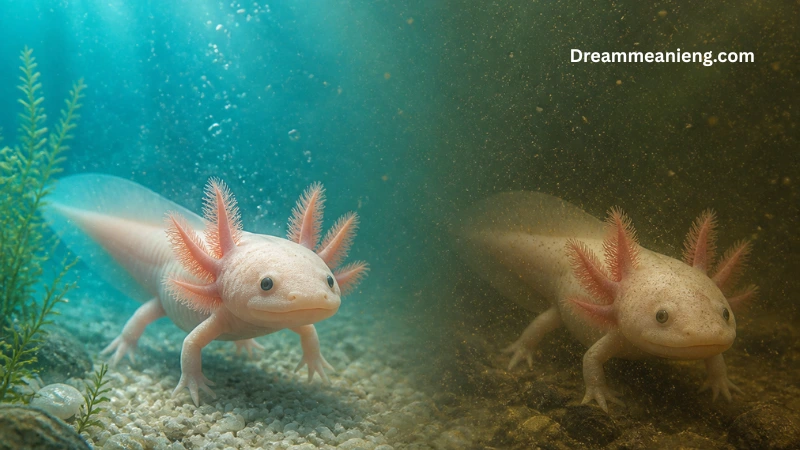
A limb regrows while the axolotl stays calm. Picture a tiny front leg slowly reappearing in your bathroom sink while you feel quietly relieved. It can fit anyone who is recovering while still showing up to work, say, after a brutal season. The dream suggests steady resilience, not a quick fix.
The axolotl is injured and you panic or feel ashamed. Here, the injury matters less than the fear of being seen. If you find yourself hiding the animal from visitors, that can mirror a worry that your grief, illness, or struggle shows on your face at work or at family dinners.
A dead axolotl. Rarely a prediction of anything literal. More often it marks a coping style, a role, or a whole season of life that has run its course. In Freudian terms, the animal is the manifest content, and the latent content is whatever you’re quietly letting go. Sadness points toward mourning. Relief points toward release.
A baby or newborn axolotl. That tiny, translucent hatchling usually stands for something fragile and just begun: a new project, a new relationship, a budding confidence. If you felt protective, take the hint. Give the thing some gentle structure before you demand results.
What Does the Water in an Axolotl Dream Mean?
The water in an axolotl dream shows how safe your emotional environment feels: clear water signals clarity, murky water signals confusion or fatigue, and a cramped tank signals a situation that limits you. Because axolotls live entirely underwater, the same axolotl dream meaning shifts noticeably when the water changes.
Clear water. A pale axolotl drifting through clean, still water in a quiet room suggests emotional transparency and privacy that feels safe. Think of it as a rehearsal for what calm self trust feels like.
Murky or dirty water. Cloudy or green water often reflects shame, tiredness, or feelings you haven’t named yet. Notice that the axolotl keeps swimming anyway. Usually the dream is saying the environment needs to change, not that you’re failing.
Trapped in a tank or pressed against the glass. An axolotl circling a cramped tank can mirror a role where you function but don’t thrive: a job with shifting expectations, say, or a household where conflict gets avoided. Low or overheated water sharpens that reading.
Out of water. Finding one on a kitchen counter or a road points to exposure without support, like being expected to bounce back fast. If you rescue it, the dream is about restoring the conditions that let you recover. Think firmer boundaries, lighter obligations, more rest.
What Does It Mean to Hold, Get Bitten by, or Become an Axolotl?
How you interact with the axolotl shows how you relate to your own sensitivity: holding one signals readiness for careful growth, a bite signals a defended boundary, and becoming one signals a shift in identity.

Holding or touching an axolotl
An axolotl resting in your cupped hands, or nudging your fingertip without fear, suggests you’re ready to nurture a part of yourself that’s still forming. Real axolotls have delicate skin and need gentle handling, and that detail is the lesson: patience.
Being bitten by an axolotl
Axolotls have tiny teeth and rarely bite, so a bite in a dream feels out of character. That mismatch is the clue. A vulnerable part of you is lashing out because it’s been pushed too hard, a bit like snapping at your partner after a week of overload. The message is about boundaries, not danger.
Becoming an axolotl
Dreamed that you’d grown gills, a pink frill, or a new tail? That echoes Julio Cortázar’s short story “Axolotl,” collected in Final del juego (1956), where a man watching the animals through aquarium glass slowly merges with one. In dreams, it often marks an identity shift or a return to an earlier, softer version of yourself.
Does the colour change the meaning?
Colour adds nuance, though it isn’t a fixed code. Treat these as interpretations, not rules:
- Pale pink or white (leucistic): softness and exposure.
- Dark or black (melanoid): guarded emotions and things kept out of sight.
- Golden albino: a trait that stands out and is hard to hide.
- Colour that shifts: adjusting your expression to fit your surroundings.
How Does Your Mood Change the Axolotl Dream Meaning?
Your emotion inside the dream shapes the interpretation more than the scene itself, because the same axolotl can signal calm healing or overwhelm depending on whether you felt curious, protective, afraid, or numb.
The continuity hypothesis, championed by dream researchers such as G. William Domhoff, holds that dreams echo waking concerns, so the feelings you carry through the day often resurface at night. That makes feeling the most useful way in. Here’s a quick reference:
| Feeling in the dream | Likely meaning |
| Calm or curious | Steady healing; readiness to engage a new self |
| Protective or tender | Caring for an underdeveloped part of you |
| Fear or disgust | Resistance to change or exposure |
| Panic or helplessness | Overload; your environment needs fixing |
| Numb, walking away | Avoidance or emotional shutdown |
Two dreamers can see the exact same tank. One wakes soothed, the other uneasy, and they need different readings. That’s why a dream dictionary alone rarely satisfies.
What Do Culture, Religion, and Psychology Say About Axolotl Dreams?
Aztec myth links the axolotl to Xolotl, a god who fled sacrifice by changing shape, while Jungian psychology reads it as a Child archetype for vulnerability and renewal. No major classical dream manual interprets the axolotl, so these frameworks are the most grounded starting points.
Axolotl Dream Meaning in Aztec Tradition and Other Faiths
The axolotl is tied to Xolotl, the Aztec (Nahua) god associated with lightning, fire, and the evening star, and a twin of Quetzalcoatl. In one widely told myth, recorded by the friar Bernardino de Sahagún in the Florentine Codex, the gods sacrificed themselves so the sun could move. Xolotl refused. He fled, first as a maize plant, then as an agave, and finally as an axolotl in the water. His name is often glossed as “water monster,” though translations vary. For a fuller account, see the World History Encyclopedia entry on Xolotl.
That story hands a hiding or vanishing axolotl a pointed question: is this protection, or is it avoidance?
The animal still lives in the canals of Lake Xochimilco near Mexico City, where it’s listed as critically endangered in the wild and treasured as a symbol of Mexican identity and persistence. In spirit animal and totem traditions, it stands for gentle renewal.
Neither the Bible nor the Quran mentions axolotls, and no widely used classical dream manual lists them. So religious readings are extrapolations from water, patience, and renewal. They work best as personal reflection, not religious ruling.
What Does Psychology Say About Axolotl Dreams?
Three lenses help here, and they overlap more than they compete:
- Jung: The Child archetype, which Jung wrote about in The Archetypes and the Collective Unconscious (Collected Works, vol. 9, part 1), stands for potential, vulnerability, and renewal, and fits the axolotl’s youthful form neatly. A tender, unfinished creature in your dream can be the shadow or the inner child asking for integration, the process Jung called individuation.
- Freud: Split the dream in two: the manifest content (the animal in the tank) and the latent content (the wish or worry underneath).
- Day residue: Freud also noted how recent experiences seep into dreams, which is why a video you watched last night can show up in tonight’s tank.
Whichever lens you prefer, the axolotl dream meaning stays personal.
A tank full of axolotls can suggest several parts of the self developing at once, with none of them required to win the argument. That’s integration in action.
Why Do You Keep Dreaming About Axolotls, and What Should You Do?
Recurring axolotl dreams usually reflect either recent exposure, such as videos, games, or merchandise, or an ongoing emotional theme like recovery or burnout. Track the details for two weeks, and speak to a professional if the dreams are distressing or disrupt your sleep.
After seeing axolotls online or in games. Watched axolotl clips or played a game with them before bed? Then the dream is probably day residue with little symbolic weight. Not every dream is a message.
Recurring during a stressful period. If the dream keeps returning while you juggle deadlines, caregiving, or a recent loss, treat it as an emotional theme worth a closer look.
Recurring with nightmare like distress. If you wake frightened, dread going to sleep, or feel shaken for hours, talk to a therapist or sleep specialist. Persistent distress deserves real support, not just symbolism.
Try these journaling prompts when you wake:
- What was the water like, and does my current life feel similar?
- What part of me is trying to regrow: confidence, trust, boundaries, or play?
- Does my environment support my recovery, or does it need to change?
Some people also try lucid dreaming, becoming aware that you’re dreaming during REM sleep, to calmly watch the tank and ask the dream a question. For more on this theme, see our guides to recurring dreams and dream journaling.
Frequently Asked Questions
Is dreaming about an axolotl a good sign?
Dreaming about an axolotl is usually a good sign. The animal symbolises healing, patience, and gradual growth, especially when the dream felt calm. Distressing details such as injury, murky water, or fear do not signal doom. They point to overload or an environment that needs adjusting.
What does a dead axolotl mean in a dream?
A dead axolotl in a dream usually represents an old coping pattern, role, or phase of life ending, not a literal loss or bad omen. Your feeling decides the reading: sadness points toward grief that needs space, while relief points toward release. If the dream left you shaken, writing it down often helps.
Why do I keep dreaming about axolotls?
Repeated axolotl dreams usually come from one of two sources: recent exposure to axolotls in videos, games, or merchandise, or an ongoing emotional theme such as recovery, burnout, or sensitivity. Track the water, the action, and your feeling for two weeks. If the dreams cause distress, consider speaking with a therapist.
What does it mean if an axolotl bites you in a dream?
An axolotl bite in a dream usually signals a vulnerable part of you defending a boundary. Real axolotls rarely bite, so the surprise is the clue: you may be overloaded, cornered, or pushed too hard. The dream is about protecting your limits, not about danger, and it can follow a stretch of stress.
What is the spiritual meaning of an axolotl dream?
The spiritual axolotl dream meaning centres on renewal that is gentle and protected, not dramatic. Spiritually, the animal represents patient restoration, emotional sensitivity, and choosing surroundings that support healing. In spirit animal traditions it is linked with water, intuition, and sometimes the sacral chakra.
Does a pink axolotl mean something different in a dream?
A pink or white axolotl can carry a softer reading than a dark one. Pale, leucistic axolotls often suggest tenderness and exposure, while dark ones suggest guarded emotions. These colour meanings are interpretive, not fixed rules, so your feeling in the dream and the state of the water still matter most.
Is there a biblical or Islamic meaning for axolotl dreams?
No widely recognised biblical or Islamic dream tradition mentions axolotls, so there is no established religious meaning. Any religious reading extrapolates from themes such as water, patience, and renewal. Treat such readings as personal reflection rather than religious ruling, and consult a trusted religious scholar if the dream feels spiritually significant to you.
What does it mean to dream you are an axolotl?
Dreaming that you are an axolotl usually signals an identity shift or a return to a softer, younger version of yourself. Gills, a frill, or a new tail point to a vulnerable part of you coming forward. Calm feelings suggest acceptance of that change, while fear suggests resistance to being seen.
Is an axolotl dream a warning?
An axolotl dream is rarely a warning. It is more often a gentle signal that something in your life needs rest, protection, or time to recover. Murky water, injury, or a cramped tank point to overload in your environment, not to danger ahead. If the dream distresses you, track it and consider talking to a therapist.
Final Thoughts
Your axolotl dream meaning is personal, and it usually starts with a gentle question: what in your life is healing, and does your environment let it? Use the Water, Action, Feeling check, jot down what you remember, and treat the answer as a conversation with yourself, not a verdict.
Dream interpretation is subjective, so keep what resonates and let the rest go. Be patient with yourself. Like the axolotl, you’re allowed to heal in your own time. For more symbols, explore our complete guide to animal dream meanings.

Ayaan Shah is the founder of this website and a passionate dream analyst. He specializes in symbolic and psychological interpretations of dreams. With years of research in human behavior and subconscious mind, he aims to make dream meanings simple, clear, and accessible for everyone.



[…] blue bird in a dream most often stands for hope, calm and honest communication, a sign of good news or a freer state of […]
[…] Dreaming about a cheetah usually means you are dealing with speed, pressure or opportunity in waking life, and the cheetah’s behavior shows which one. It’s the fastest land animal, so it tends to arrive carrying urgency. But it’s also built for sprints, not marathons, and that’s the part people often miss: the dream frequently points to a burst of effort that needs a plan for rest afterward. […]