

Nose bleed dream meaning usually points to emotional exhaustion, stress that has built past your limit, or feelings you have kept quiet for too long. Blood stands for life force and the nose for intuition and identity, so watching yours bleed is understandably jarring.
But the details change everything: who is bleeding, how heavily, where you are, how you feel. Below, you will find twelve scenarios, what psychology and spiritual traditions have to say, whether the dream can hint at a real health issue, and what to do once you wake up.
Quick Answer
A nose bleed dream usually means emotional or physical depletion, stress reaching a breaking point, or suppressed feelings finally surfacing. It is rarely a bad omen. Who bleeds, how much, and what you feel in the dream change the reading: calm bleeding that stops suggests release and relief, while bleeding that will not stop points to helplessness. If you also have real nosebleeds or headaches, mention it to a doctor.
What Is the Nose Bleed Dream Meaning?
A nose bleed dream most often reflects depletion: stress, overwork or unspoken emotion reaching the point where it can no longer be contained.
Blood has long stood for life force, vitality and strong emotion, while the nose is tied to intuition, identity and breath. Put them together and your subconscious is showing you something precious slipping away. Usually that something is your energy, your composure, or a feeling you have been sitting on. Blood makes many people leap straight to danger, so this dream is easy to misread.
Most people land on one of three readings:
- Loss of vitality: burnout, overcommitment, a schedule that leaves no room to recover.
- Emotional release: suppressed anger, grief or resentment surfacing without your permission.
- A nudge to slow down: not an omen, but a prompt, the way a tired body asks for rest.
The symbols break down like this:
| Symbol | Core meaning | Waking life link |
| Blood | Life force, vitality, emotion | Where your energy is going |
| Nose | Intuition, self image, pride, breath | How you read situations and present yourself |
| Bleeding | Involuntary release or loss | What you can no longer hold in |
| Tissue or pinching to stop it | Your coping effort | Whether you feel able to manage the problem |
| Stain on pillow or clothes | Guilt or visible consequence | What you feel responsible for |
Blood turning up in lots of your dreams? Our guide to blood dream meaning digs into the wider symbol. Dreams about teeth falling out run on a similar fear, a visible loss of control. Keep in mind that dream symbols are interpretive, not scientific facts, so treat each reading as a starting point for your own reflection.
What Does It Mean When Your Own Nose Is Bleeding in a Dream?
Dreaming that your own nose is bleeding usually signals personal stress overflowing in a visible way that is hard to hide.

Watch how the bleeding behaves. It tells you how much control you feel you have in waking life. These four versions turn up most:
- Sudden bleeding with no cause. You are walking through an ordinary scene and blood just appears. No fall, no hit, nothing. That tends to mirror stress that built up quietly and surfaced before you noticed, much like the wired, tired feeling at the end of a long month.
- Bleeding that will not stop. You press tissue to your nose and it soaks straight through. Helplessness is the theme: a problem or obligation that feels bigger than your ability to fix it, a caregiving load or a growing debt, say.
- Heavy bleeding from both nostrils. Two nostrils, two leaks. More than one area of life is draining you, maybe your job and a relationship at the same time.
- Calm bleeding that stops quickly. If you feel steady and the flow eases, that is a good sign. It points to release and relief, tension already loosening, a turning point not far off.
Your own feeling in the dream matters as much as the blood. Panic points to feeling overwhelmed and unequipped; calm hints that you are closer to coping than you think.
What Does It Mean When Someone Else Has a Nosebleed in Your Dream?
A nosebleed on another person in a dream usually reflects your concern for that person or strain in your relationship with them.
The nose bleed dream meaning shifts with who is bleeding, because every relationship carries its own kind of worry:
- Your partner. Think unspoken strain, or a conversation you keep putting off. One of you may be carrying more than the other admits.
- Your child. Here the worry is protective: the fear that you cannot shield them from something. New parents see this one a lot, and so do parents of a child in a rough patch.
- Your parent. Expect concern, a sense of role reversal, or family stress that never got resolved. It tends to show up when a parent’s health, aging or an old conflict is on your mind.
- A stranger. A bleeding stranger is trickier. In Jungian terms, the unknown figure can stand for a disowned part of yourself, a strain you have not yet admitted.
Whichever version you saw, ask who in your life seems quietly depleted. Then ask whether it might be you.
Does the Setting Change the Meaning of a Nose Bleed Dream?
Yes, the setting changes the meaning of a nose bleed dream because it shows which area of life is under pressure: public places point to fear of judgment, exams to performance stress, water to private emotional overflow, and a helper at your side to how supported you feel.
This is why nose bleed dream meaning is never one size fits all. Four settings come up most:
- Bleeding in public. An audience adds shame and exposure, and it leaves you vulnerable. Much like dreams of teeth falling out, it taps the fear of looking weak at the worst possible moment.
- During an exam or presentation. Performance pressure, plus that quiet worry about being found out.
- In the shower or water. Water often stands for emotion, so blood mixing with it points to feelings spilling over in private, away from any audience. If you feel calm, it can read as emotional cleansing.
- Someone helping you stop the bleeding. A friend or stranger handing you tissue shows how supported you feel. Accepting help suggests you are ready to share the load; refusing it suggests you are trying to cope alone.
And here are all twelve side by side:
| Scenario | Likely meaning | Question to ask yourself |
| Sudden bleed, no cause | Stress surfacing before you notice it | Where am I running on empty? |
| Bleeding that will not stop | Helplessness about a problem | What feels beyond my control? |
| Heavy bleeding, both nostrils | Several areas draining you at once | What takes the most from me? |
| Calm bleeding that stops quickly | Release, relief, a turning point | What tension is easing? |
| Partner bleeding | Unspoken strain in the relationship | What have we not discussed? |
| Child bleeding | Protective anxiety | What can I not shield them from? |
| Parent bleeding | Concern or unresolved family stress | What do I owe or fear here? |
| Stranger bleeding | A disowned part of you under strain | What am I ignoring in myself? |
| Bleeding in public | Fear of being seen as weak | Whose judgment do I fear? |
| During an exam or presentation | Performance pressure | What am I afraid of failing at? |
| In the shower or water | Private feelings spilling over | What am I feeling that nobody sees? |
| Someone helps you stop it | How supported you feel | Who could carry some of this with me? |
What Does Psychology Say About Nose Bleed Dreams?
Psychological approaches generally read a nosebleed dream as the mind dramatizing stress or emotion it has not yet processed, not as a prediction of anything to come.
Three lenses help most:
- Jungian view: Carl Jung believed dreams compensate for whatever the conscious mind overlooks. A nosebleed can signal shadow material, a truth or repressed feeling from the unconscious forcing its way into awareness. The nose is linked with intuition, so there may also be a gut feeling you have been ignoring.
- Cognitive view: A CBT informed reading sees anxiety and catastrophizing at work. The dream stages a worst case, like losing control in front of others, and shows you how much you fear it.
- Dream research: Dreaming is most vivid in REM sleep, and researchers behind the continuity hypothesis find that dreams tend to reflect waking life experiences, so a stressful week often produces stressful imagery. That incorporation is usually distorted, which is why the link to your day may not look obvious.
Freud would add a more suspicious twist: that sudden, messy release might stand in for repressed anxiety, or for an impulse you keep tightly in check.
Spiritual and Cultural Nose Bleed Dream Meaning
Christian readings of nose bleed dream meaning focus on stewarding your energy and wellbeing, Buddhist readings on impermanence and letting go, and Islamic interpretation on the details of the dream and the dreamer’s circumstances.
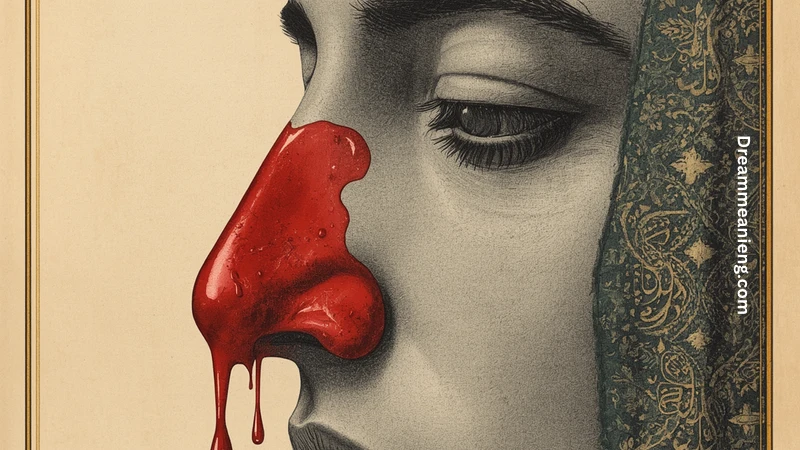
Four perspectives are worth knowing, and they do not always agree.
Christian readings: stewardship and renewal
Christian readings treat a nosebleed dream as a call to steward your energy and wellbeing more faithfully. Leviticus 17:11 says the life of a creature is in the blood, and blood also carries ideas of sacrifice, atonement and purification. Many readers hear a call for spiritual cleansing and renewal, and perhaps a reason to pray or slow down.
Islamic readings: details and context
Islamic dream interpretation reads a nosebleed by its details and the dreamer’s circumstances, so no single meaning fits everyone. The classical manual Ta’tir al-anam, in Yasmine Seale’s selected translations, says a nosebleed whose blood touches your garment signals unlawfully gained money, while thick blood signals a child. One way to hold that is as a prompt to reflect on earnings and conduct. For a personal reading, a qualified scholar is the best guide.
Buddhist readings: impermanence and letting go
Buddhist teaching treats the body as impermanent, so a bleeding dream can prompt you to ask what you are gripping too tightly. Read this way, the image is less a bad sign than an invitation to release old patterns and meet your own suffering with compassion. This is a modern reflective reading, not a fixed Buddhist rule for interpreting dreams.
Folk belief and everyday language
Folk belief has long treated sudden bleeding as a warning or premonition. A 17th century writer, quoted in an 1890 study of superstitions, mocked people whose mood collapsed because a few drops from the nose seemed to promise bad luck. Everyday language shapes the symbol too: “pay through the nose” suggests costly sacrifice, “led by the nose” suggests being controlled, and “keep your nose clean” suggests staying out of trouble. No wonder the nose carries ideas of pride, control and discernment.
Is a Nose Bleed Dream a Sign of a Health Problem?
A dream nosebleed is a symbol, not a symptom, so it does not by itself indicate illness.
That said, the body and the dreaming mind talk to each other more than we tend to think. Three situations are worth telling apart:
- Dream only, no physical symptoms: treat it as a stress signal and look at your workload, sleep and emotions.
- Waking with a real nosebleed or blood on the pillow: dry air, irritation or allergies are common causes, and your sleeping brain may have woven the sensation into the dream.
- Recurring dreams plus fatigue, headaches or dizziness: see a doctor, and review your sleep and stress levels at the same time.
The NHS says nosebleeds are not usually a sign of anything serious, but see a GP if they come regularly, and get emergency help if one lasts longer than 10 to 15 minutes. NHS patient leaflets add that frequent or heavy nosebleeds can point to problems such as high blood pressure or a clotting disorder.
What Should You Do After a Nose Bleed Dream?
After a nose bleed dream, write down the details while they are fresh, then pick one source of pressure you can reduce this week.
A few small steps turn an unsettling dream into something useful:
- Capture the details. Write down who bled, where you were, how much blood there was and what you felt before it fades.
- Ask what is overflowing. Pick the one or two parts of your week that feel like they are running over: a deadline, a tense relationship, money worries.
- Take one concrete step. Book an evening of real self care, turn down one optional favor to protect a boundary, or finally raise the topic you have been avoiding.
- Watch for a repeat. If the dream returns, compare the days leading up to each one. A dream journal makes triggers easier to spot.
Treat the dream as a signal about stress, not a verdict on your future. Think of a smoke alarm: annoying when it goes off, but you would not want it silent.
Frequently Asked Questions
The seven most common questions about nose bleed dream meaning are answered briefly below, from whether it is a bad omen to how to stop recurring dreams.
Is a nose bleed dream a bad omen?
No, a nose bleed dream is not a bad omen by default. It most often reflects stress, exhaustion or suppressed emotion that needs attention. Bleeding that stops, or that brings relief, usually signals release, so the dream works better as a gentle prompt to rest and reflect than as a warning of disaster.
Why do I keep dreaming about nosebleeds?
Recurring nosebleed dreams usually track ongoing stress or an unresolved emotional issue, because the pressure behind them has not eased. Compare what was happening in your life before each dream, such as deadlines, arguments or poor sleep. Once the common thread shows up, easing it tends to quiet the dream.
Does dreaming of a nosebleed mean I am sick?
Dreaming of a nosebleed does not usually mean you are sick. A dream nosebleed is a symbol of stress, emotion or depletion, not a diagnosis. If you also have regular real nosebleeds, headaches, dizziness or unusual fatigue, see a doctor, because those symptoms deserve medical attention whatever you dreamed.
Why did I wake up with a real nosebleed after dreaming of one?
A real nosebleed during sleep may be folded into a dream, much as waking-life experiences are incorporated into dream content. Dry air, nasal irritation and allergies are common causes. One episode is usually harmless, but nosebleeds that keep returning, or that last longer than 10 to 15 minutes, need medical attention.
What does the Bible say about a nosebleed in a dream?
The Bible does not mention nosebleeds in dreams directly. Readers usually turn to Leviticus 17:11, which teaches that the life of a creature is in the blood, and treat the dream as a prompt to examine how they spend their energy, rest and wellbeing, rather than as a punishment or prophecy.
What does a nosebleed dream mean in Islam?
Islamic dream interpretation depends heavily on the details of the dream and the dreamer’s circumstances. A classical manual, Ta’tir al-anam, links a nosebleed whose blood touches your garment to unlawfully gained money, and thick blood to a child. For a personal reading, consult a qualified scholar of dream interpretation.
How do I stop recurring nosebleed dreams?
Easing the stress behind recurring nosebleed dreams is the best place to start. Keep a regular sleep schedule, wind down without screens in the hour before bed, and write down the dream after waking to name its trigger. If the dreams persist or leave you distressed, a therapist can help you work through the underlying pressure.
Conclusion
Nose bleed dream meaning comes down to this: something in your life is asking for care, whether that is your energy, a feeling you have held back, or a situation that feels out of your control. The image can be startling, yet it is rarely a warning of harm.
Often, it is your mind’s blunt way of saying you have been giving out more than you take in. Look back at who bled, where you were and how you felt. Then let those details guide one small, kind change. If you also have physical symptoms, please see a doctor. And whatever you dreamed last night, go easy on yourself today. Rest is allowed.