

Storm dream meaning usually comes down to pressure: stress, conflict, or change building faster than you can deal with it. You wake up with your heart pounding, still half hearing the thunder, and wonder whether it was a warning or just a rough night.
Honestly, it’s rarely either. Your mind borrows the force of real weather to show you what you’re carrying, and how the storm ends tells you more than how loud it got. Here’s what different storm dreams mean, why they happen, and what to do about them when they keep coming back.
Quick Answer
Storm dream meaning most often points to emotional turbulence: stress, conflict, or a change you can feel coming. Being caught in the storm suggests overwhelm, watching from a distance suggests anticipation, and calm afterward usually signals relief and renewal. How violent the storm looked matters less than what you felt, where you stood in the dream, and what was left when it passed.
Storm Dream Meaning at a Glance
Most storm dreams fall into a few patterns: overwhelm when you are caught in the storm, anticipation when you watch it coming, and release when it passes. Use the table to find your scenario, then read the matching section below for the detail.
| Scenario | Likely meaning | Common waking life trigger |
| Caught in a storm | Overwhelm, exposure | Burnout, crisis at work or home |
| Storm approaching | Anticipation | Deadline, big conversation |
| Watching from a window | Observation, distance | Avoiding a decision |
| Taking shelter | Coping, resilience | Seeking support |
| Storm that never breaks | Avoidance, tension | Postponed choice |
| House destroyed | Threatened security | Family or money stress |
| Flooding | Emotional overflow | Accumulated tasks or grief |
| Calm after the storm | Release, renewal | Conflict resolved |
What Does It Mean When You Dream About a Storm?
A storm in a dream usually represents emotional pressure that has built up faster than you have processed it. The storm’s intensity mirrors how urgent the feeling is, and the ending shows whether you are resisting it or releasing it.
Real storms form where warm, moist air meets cooler air or rises unstably, and dream storms often form where two forces in your life collide. In practice, storm dream meaning falls into three camps. The first is emotional overload: anger, grief, or worry you haven’t said out loud, dressed up as weather. The second is conflict, either with another person or between two parts of yourself that want different things. The third is change, the kind that clears out whatever stopped working.
To work out which camp your dream belongs to, try a simple three step check called the Position, Emotion, Outcome decoder. Where were you: inside the storm, watching it, or sheltering? What did you feel: fear, awe, relief? And what was left behind afterward?
That last question is easy to overlook, and it often matters most. A useful rule of thumb is that a violent storm that ends in calm usually reads as release, while a mild storm that never breaks often points to something you keep putting off.
The decoder in practice
These three examples are composites built from common dream patterns, not accounts from individual readers.
- Watching from a kitchen window as clouds roll in, but the storm never arrives. Position: watching. Emotion: dread with a little curiosity. Outcome: nothing happens. Likely reading: a conversation or decision you keep expecting to have, and keep postponing.
- Driving at night through hail, then pulling over under a bridge as it passes. Position: inside, then sheltered. Emotion: fear, then relief. Outcome: calm. Likely reading: a stressful stretch you are handling by slowing down, with relief on the way.
- Standing in a flooded childhood home as the rain stops. Position: inside. Emotion: sadness. Outcome: clearing sky. Likely reading: old grief surfacing and beginning to settle.
What Does It Mean to Be Inside a Storm in a Dream?
Being inside a storm in a dream typically signals feeling overwhelmed, exposed, or under pressure you cannot yet step away from. How you move through it, whether you shelter, push on, or freeze, often mirrors how you handle stress when awake.
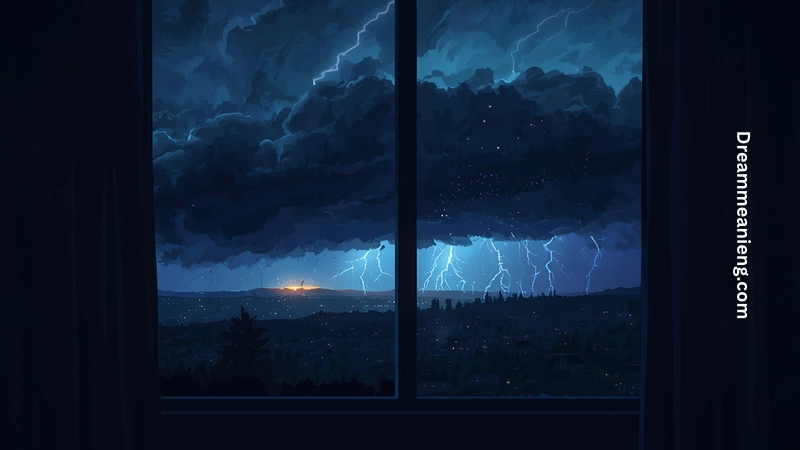
Even small choices inside the dream, like which way you ran, can offer clues.
Caught in a Storm With Nowhere to Hide
Being caught in a storm usually signals overload and a lack of support. Rain soaking through, no cover in sight, a sense that nobody is coming. This often shows up when work, family, or money pressure has stacked up with no breathing room. Your reaction offers clues too: freezing can mirror shutting down under stress, while pushing on can suggest you cope through sheer effort.
Driving Through a Storm
Driving through a storm usually points to how much control you feel you have. You’re at the wheel, so this one is about agency. Notice what you reached for: slowing down, pulling over, or pushing harder. Arriving safely suggests you may be handling more than you credit yourself for, while skidding or losing the road can point to the limits of control, or to the strain of pushing on alone.
Being Chased by a Storm
Being chased by a storm usually points to avoidance. A storm you keep fleeing tends to follow you from dream to dream. Many people wake exhausted, as if they had been sprinting. Turning to face even one small piece of the problem often takes some of the panic out of it.
A Storm at Sea or on a Boat
A storm at sea usually means emotion without solid footing. Are you steering, or just holding on? Steering suggests you’re managing the feeling, and drifting suggests it’s managing you. A calm patch between the waves may mark a pause your mind is asking you to take.
What Does It Mean to Watch or Prepare for a Storm in a Dream?
Watching or preparing for a storm in a dream points to anticipation: you sense a conflict or change coming and are deciding whether to act or wait. The distance between you and the storm shows how much time you feel you have.
The farther away the storm, the more room you believe you have to maneuver.
A Storm Approaching on the Horizon
A storm on the horizon usually means something with a date attached is closing in. Think of a deadline, a hard conversation, or a decision you can’t dodge forever. Dark clouds stacking up, with the air gone strangely quiet, often match a feeling you haven’t voiced yet.
Watching a Storm From a Window
Watching from a window can mean wise caution or quiet detachment. Only you can tell which. A simple test: after the dream, did you feel calmer and clearer, or restless and stuck? Restlessness suggests the glass has turned into a wall.
Taking Shelter or Protecting Someone
Sheltering or protecting someone usually reflects caregiving instinct. Think of hiding in a basement or pulling a child close. Who you shield is worth noticing. It may be someone you worry about in daily life, or a stand in for a side of you that feels unprotected.
A Storm That Never Breaks
A storm that never breaks usually reflects tension without release. Thunder rolls, clouds pile up, and nothing falls. It often fits a postponed choice, and in these dreams relief tends to come from acting, not waiting.
What Does a Storm Dream Mean When Something Gets Damaged or Survives?
Storm damage in a dream points to what feels at risk in waking life, while a storm you survive points to resilience. Houses, vehicles, and water usually map to security, direction, and emotion.
Damage dreams feel heavy, but they can be the most useful ones, because they name what you’re worried about.
A Storm Destroys Your House
A destroyed house usually points to something that feels structurally unsafe in your life. In dreams, a house frequently stands for you or your family. A ripped off roof or flooded floor is worth taking seriously, though not literally. Ask whether the shaky thing is a relationship, your finances, or your sense of who you are. A power outage in the dream can add another layer, often pointing to lost clarity or resources.
Lightning Strikes
Lightning in a dream usually signals sudden shock or sudden insight. Where it lands changes the weight. A strike on your home suggests news that lands close, a strike on a tree nearby suggests something that affects you at one remove, and a near miss suggests a warning with time left to act.
Flooding After the Storm
Flooding after a storm usually represents accumulated overwhelm spilling over. Think of emails, chores, grief, and bills. Brown, debris filled water often fits murky feelings you can’t yet name, and clear water fits emotion that is strong but easier to face. Wading out to dry ground suggests more resilience than you feel.
Calm, Sunlight, or a Rainbow Afterward
Calm after a storm usually signals relief, resolution, and hope. A rainbow often stands for reconciliation or the sense that the worst has passed. One caution: relief can arrive tangled up with grief, so don’t rush past whatever the storm took.
What Do Different Types of Storms Mean in Dreams?
The type of storm changes the emotional flavor of the dream: thunderstorms suggest sudden insight or confrontation, hurricanes prolonged upheaval, tornadoes sudden disruption, and snow or sand storms emotional numbness or lost direction.
| Storm type | Core symbolism | Distinct reading |
| Thunderstorm and lightning | Confrontation, sudden insight | Thunder with no rain can feel like a threat that never lands, such as a warning you keep expecting. Rain with no thunder fits quiet grief. |
| Hurricane or tornado | Loss of control | A hurricane suggests slow, wide upheaval. A tornado suggests a sudden, narrow disruption. |
| Snowstorm or blizzard | Numbness, lost direction | A whiteout suggests you can’t see a clear next step. |
| Sandstorm or dust storm | Irritation, blocked clarity | One common reading ties it to friction from repeated small stressors. |
Hail often reads as sharp, repeated hurt. A tsunami is not a weather storm, but its meaning sits close to flooding: sudden, total overwhelm. If your dream centered on one of these, see our separate guides to tornado dreams, hurricane dreams, flood dreams, and lightning dreams.
What Does a Storm Dream Mean in Love, Family, or Grief?
In relationships, a storm dream usually shows the emotional weather between you and another person, and the other person’s role in the dream hints at what is unresolved.
- A partner or ex in the storm: unspoken conflict or unfinished business. A storm between you suggests tension, and sheltering together suggests commitment under pressure.
- A deceased relative in the storm: often grief and unfinished conversations. A storm that passes can reflect the slow easing of loss, though grief rarely follows a straight line.
- A child in the storm: protectiveness, parenting worry, or fear of not being able to fix everything.
Storm Dream Meaning in Psychology
Many dream researchers see storm dreams as the mind turning strong emotion into a vivid image, so a storm often appears when stress, anger, or grief has not yet been put into words. No single storm symbol works as a fixed code.
Emotion as image
Hartmann proposed in 1998 that the dreaming mind picks a central image to carry strong feeling, and he often used tidal waves as an example. A storm does the same job: it is big, loud, and impossible to ignore, just like the emotion underneath. Takeaway: the bigger the image, the stronger the feeling behind it.
Threat simulation and continuity
Antti Revonsuo proposed in 2000 that dreaming evolved partly to rehearse threats, and storms make a tidy rehearsal: huge, fast, and hard to control. The continuity hypothesis, associated with G. William Domhoff, adds that dreams draw on waking concerns and recent experience, so a weather alert before bed can turn into a storm at 3 a.m.
The Jungian reading
A Jungian reading might treat the storm as shadow material: anger or grief you have decided is unacceptable, pressing for attention. Jung did not assign storms a fixed meaning, so this is one way analysts apply his ideas.
Stress, sleep, and trauma
Stress can make sleep lighter and more fragmented, which may make dreams easier to remember. Some researchers link REM sleep to emotional processing, though its exact role is still debated. Real thunder or wind outside can also slip into a dream and take over the plot. An occasional anxiety dream is ordinary. If storm imagery replays a real disaster and leaves you shaken, that can be a sign of trauma related nightmares. Only a clinician can say, so it is worth talking to one.
Spiritual and Biblical Storm Dream Meaning Across Cultures
Across traditions, storms stand for power that both destroys and renews, so the dream reading depends on whether the storm brings judgment, testing, or rain. No tradition gives one fixed meaning, and teachers within each faith differ.
These are broad sketches, not rulings. If you practice a faith, your own teachers matter more than any article, this one included.
| Tradition | Storm symbolism | Dream reading note |
| Christian | Divine power, testing, protection (Jesus calming the storm in Mark 4, Jonah, Job) | Peace in the storm suggests trust. A storm as a call to change suggests conscience. |
| Islamic | Thunder as praise of God, rain as mercy, destructive storm as trial | Context and the dreamer’s condition shape the reading. Consult a qualified teacher. |
| Jewish | Awe before creation’s power, with a traditional blessing for thunder and lightning | A storm may prompt reflection on humility and repair. |
| Hindu and Buddhist | Indra’s thunderbolt and rain; impermanence | Storm as passing mental weather, lightning as sudden insight. |
| Chinese | Thunder deities tied to moral order and balance | A storm may suggest a situation needs rebalancing. |
| Greek and Norse mythology | Zeus and Thor wielding thunder as authority | Storm as accountability or the power of a deity. |
In Christian settings, the calming of the storm in Mark 4 is the best known example, and Jonah’s story shows a storm as a consequence that pushes someone to change course. In the Book of Job, God answers out of a whirlwind, which makes the storm a place of revelation as much as fear.
In Islamic tradition, the Quran says the thunder glorifies God’s praise (13:13) and describes rain as mercy. Works traditionally attributed to Ibn Sirin stress the dreamer’s state and circumstances, and many Muslims would take a dream like this to someone knowledgeable instead of relying on a quick online lookup.
Many Indigenous and African traditions treat storms as living powers or messages tied to land, ancestors, and season. These vary widely by community, so local teachers are the right guide, and outsiders should avoid borrowing sacred stories.
For readers drawn to a modern spiritual angle, a storm dream is sometimes read as a cleansing or a spiritual awakening, an omen that something old is breaking so something new can form. That is a lens, not a law.
Is a Storm Dream a Good or Bad Sign?
A storm dream is neither automatically a bad omen nor a good one: the outcome, your emotion, and your waking context decide the reading. A storm that ends in calm usually suggests release, while one that destroys without relief usually flags overload.
The omen question gets far too much airtime. Storm dream meaning is rarely fixed, which is exactly why the good or bad verdict trips people up. Three patterns cover most cases:
- Destruction plus dread: boundaries or support are probably under strain.
- A storm that passes, with a clean, quiet aftermath: release and renewal.
- A storm that never breaks, or one you keep running from: a pending decision.
People in big transitions often describe these dreams: grief, a breakup, pregnancy, a move, or a new job. People in storm prone regions and trauma survivors also report them. There is no solid data on who dreams of storms most, so treat this as a pattern, not a statistic, and read the dream as a reflection of your current season, not a prediction.
What Should You Do After a Storm Dream?
After a storm dream, write down three things (where you stood, what you felt, what remained), then choose one small action tied to the stress it points to. Recurring storm dreams that disturb sleep may benefit from imagery rehearsal or professional support.
You don’t need an elaborate ritual. Start small:
- Journal it. Keep a dream journal by the bed and run the Position, Emotion, Outcome decoder on your entry. Two minutes is plenty.
- Act on one thing. Pick one boundary or one conversation that would take pressure off, and do it this week, not someday.
- Rewrite the ending. If the same storm keeps returning, try imagery rehearsal therapy, a well studied technique for nightmares. While awake, rewrite the dream with a safer ending, then rehearse that version daily.
- Ground yourself. On nights you wake rattled, try slow breathing or naming five things you can see.
If storm nightmares are frequent, trauma linked, or draining your days, talk to a therapist. That’s not an overreaction. It’s using the right tool.
Frequently Asked Questions
Is dreaming about a storm a bad omen?
A storm dream is not a bad omen by default. It reflects emotion more than fate, and the reading depends on what you felt, what the storm did, and how it ended. A storm that clears into calm often signals relief, while one that leaves wreckage points to overload.
Why do I keep dreaming about storms?
Recurring storm dreams usually track ongoing stress or something you keep avoiding. Note when they cluster, such as deadlines, arguments, or a hard decision, because storm dream meaning is usually found in what was happening just before the dream. If the pattern fits, tackling one small piece of the problem often quiets it.
What does it mean to dream about surviving a storm?
Dreaming about surviving a storm usually reflects resilience. It suggests you sense you can get through a hard stretch, even if the dream felt frightening. Notice who helped you and what you used for shelter, because those details often point to real sources of support.
What is the spiritual meaning of a storm in a dream?
Many people read a storm as cleansing, testing, or a push toward change. Thunder is often heard as a wake up call and rain as renewal. Meanings differ by tradition and belief, so treat spiritual readings as a lens for reflection, not a fixed rule.
What is the biblical meaning of a storm in a dream?
Biblical storms usually show God’s power, testing, or protection, as in Mark 4, where Jesus calms the storm, and in the story of Jonah. A storm dream may be read as a call to trust, repent, or change course, depending on your own faith.
Can a storm dream mean anxiety or trauma?
A storm dream can reflect anxiety or trauma, especially when it repeats or leaves you distressed, but it is not a diagnosis. Storms often carry stress, fear, or unresolved grief. If nightmares are frequent, trauma related, or affecting your days, a therapist can help.
Why do I dream about storms when I’m not stressed?
Storm dreams can appear without obvious stress. Common causes include excitement about a coming change, recent weather news or films, real thunder or wind during sleep, and disrupted sleep. Sometimes the brain simply reuses vivid imagery, so not every storm dream is a message about a problem.
Do storm dreams predict the future?
There is no scientific evidence that dreams predict events, so a prophetic reading deserves caution. Storm dreams are better read as emotional signals about what you feel now or expect soon. If a dream nudges you to act on a real concern, that’s useful, but it isn’t a forecast.
Conclusion
Storm dream meaning rarely arrives as a verdict. Think of it as a mirror with weather in it. The storm shows the pressure you’re under, your position in the dream shows how you’re coping, and the aftermath hints at what comes next.
Notice what you felt, name what’s building, and take one small step toward it. Then let the dream do its job and pass. If you’re curious where to go next, our guides to flood, tornado, and lightning dreams pick up where this one leaves off.




[…] Dreaming about a stalker usually means that a worry, a person, or a memory is following you through waking life and you have not faced it yet. Your subconscious turns that avoidance into a pursuer, because a pursuer is impossible to ignore. […]