
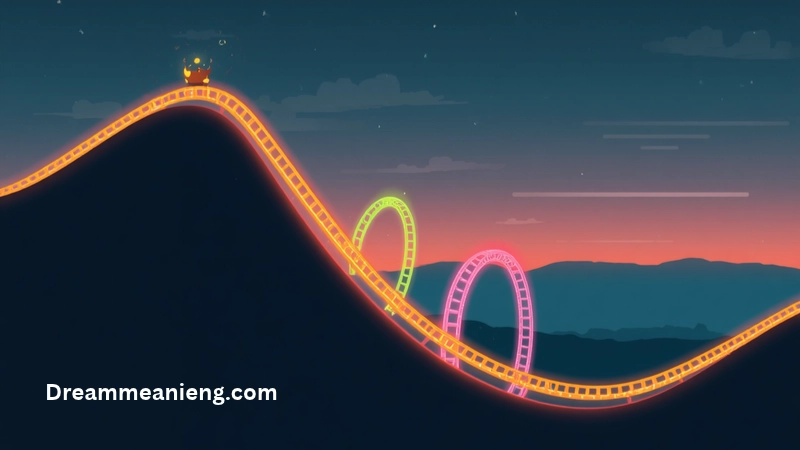
Roller coaster dream meaning usually points to a stretch of life with sharp highs, sudden drops and very little control over the pace. You wake with a racing heart, unsure whether that was fun or awful. Hold on to that confusion, because it is the clue.
Your mind borrows the coaster to talk about change, risk and not knowing what comes next. Below, you’ll find what each moment of the ride means, from the first climb to the last drop, along with psychological, religious and cultural views. Take what fits and leave the rest.
Quick Answer
A roller coaster dream usually reflects a period of emotional ups and downs where you feel strapped in and not fully in control. Thrill suggests you are welcoming change, while fear signals anxiety about risk or uncertainty. The drop points to a loss of control, the climb to anticipation, and wanting to get off to exhaustion. Treat it as a mirror of your current stress level and pace of life, not a prediction.
What Does a Roller Coaster Dream Mean?
In most cases, roller coaster dream meaning comes down to how much control you feel you have over a period of rapid change. A coaster packs anticipation, risk and surrender into one image, and the mind loves a shortcut.
You climb slowly. You hang there for a breath. Then gravity takes over, which is exactly how change feels when life outruns your planning.
Three settings come up again and again:
- A job change in progress. An offer is pending, probation is ending, or layoff rumors are doing the rounds. Your subconscious mind is rehearsing a future you cannot see yet.
- An on and off relationship. Close, then distant, then close again. The dream mirrors emotional volatility you may have stopped noticing while awake.
- Burnout or a run of bad news. The coaster here is not about one event. It is about the pace of life itself, and how tired of it you are.
Carl Jung believed dreams compensate for whatever the waking mind overlooks. So if you keep insisting you are fine, the coaster may be the part of you that politely disagrees.
Roller Coaster Dream Meaning by Scenario
Each stage of a roller coaster ride maps to a distinct feeling: the climb signals anticipation, the drop signals lost control, and loops signal disorientation. Crashes and falling off reflect fear that a risky plan or relationship will fail.
Find your scene in the table below, then ask what was going on in your waking life that week. These are widely used readings, not scientific certainties, so your own associations matter most.
| Scenario | Common interpretation | Common waking life trigger |
| Slow climb up the first hill | Anticipatory anxiety before a known event | Exam, surgery date, wedding, interview |
| The first big drop | Sudden loss of control or unwanted news | Layoff notice, breakup, unexpected bill |
| Loops and corkscrews | Disorientation, priorities feel flipped | Career pivot, relocation, identity change |
| Stuck at the top | Stalled progress and dread of the next step | Waiting on a decision or result |
| Coaster crashes or derails | Fear that a risky plan will collapse | Business launch, big loan, relationship risk |
| Falling off the coaster | Fear of failing to hold on | Slipping grip at work or in a relationship |
| Driving or steering it | Wanting control, or finding you have more than you think | Taking charge after a period of drift |
| Riding with a partner or ex | The relationship is the source of the swings | On and off relationship, unresolved feelings |
| A child on the ride | Protectiveness and worry about their risks | New parent, child starting school |
| Being forced onto the ride | Pressure into a change you did not choose | Family expectations, mandated move |
| Empty or abandoned amusement park | Loneliness, or the thrill has gone | Burnout, flat feeling after a big event |
| Ride ends and you step off safely | Reassurance that the turbulence passes | End of a hard season |
What Does It Mean to Dream of Driving or Controlling a Roller Coaster?
Driving or controlling a roller coaster in a dream reflects a wish for control over something you cannot fully steer, or the discovery that you have more say than you thought.
A coaster runs on a fixed track, so dreaming that you are driving one often reveals a wish for control over something you cannot actually steer, such as another person’s choices or an outcome that depends on timing. Occasionally it means the reverse, and you have more say than you realized.
What Does It Mean to Dream of Falling Off a Roller Coaster?
Falling off a roller coaster in a dream signals a fear of failing to hold on to something you care about, such as a job, a relationship or your own composure.
Pay attention to the safety bar. If it popped open by itself, the dream often points to feeling let down by a system you trusted. If you let go on purpose, you may be carrying a quiet wish to quit.
What Does It Mean When a Roller Coaster Crashes or Derails in a Dream?
A roller coaster that crashes or derails in a dream reflects a fear that a risky plan, relationship or commitment is about to collapse.
Look at who was on board. Strangers suggest a fear of failing in public, while family suggests a fear of letting them down. Plenty of people wake up convinced it was a premonition. I read it as a stress test instead, where your mind runs the worst case so you can look at it in daylight.
What Does It Mean to Ride a Roller Coaster With Someone in a Dream?
Riding a roller coaster with someone in a dream shows that your bond with that person is tied to the ups and downs you feel.
A partner suggests shared turbulence. An ex suggests an old pattern still shapes how you respond to closeness. A friend usually means support, while a stranger can mean you feel you are facing change with nobody familiar beside you. And if someone who has died sits next to you, the dream is often about grief, which also comes in waves.
What Does Your Feeling During the Ride Reveal?
The emotion you feel during a roller coaster dream matters more than the ride itself: thrill points to readiness for change, fear points to anxiety about a specific risk, and nausea points to emotional overload.
| Feeling in the dream | Likely meaning |
| Thrilled and laughing | Appetite for change, readiness to take a risk |
| Terrified, gripping the bar | Anxiety about one specific upcoming risk |
| Nauseous or dizzy | Too many changes at once, emotional overload |
| Wanting to get off | Exhaustion, a need for rest before decisions |
| Calm and detached | Acceptance, or emotional numbness (ask yourself which fits) |
| Scared first, then exhilarated | May signal courage forming before a leap |
Most guides skip one detail: the last feeling before you wake. If fear turns into exhilaration by the end, courage is often taking shape. If thrill curdled into dread, a plan you enjoy may hide a risk you have not looked at yet.
Is Roller Coaster Dream Meaning Good or Bad?
A roller coaster dream is neither good nor bad by default. It is a positive sign when you feel thrilled or calm, and a stress signal when you feel terror, nausea or panic.
Adrenaline in the dream shows what your nervous system is doing with the change in your life. Think of it as a mood ring, not a verdict. Joy says you are leaning in. Panic says you need support, information or rest.
Roller Coaster Dream Meaning in Psychology, Religion and Culture
Psychologists read roller coaster dreams as the mind rehearsing emotional intensity and control, while religious and cultural traditions read them as lessons about fate, seasons and trust.
Your sleeping mind speaks in pictures, and few pictures carry as much human history as a rise and fall.
Psychological views
Psychologically, a roller coaster dream most often reflects waking life concerns and emotional arousal. Start with the boring explanation, because it is often right: the continuity hypothesis, which traces back to Calvin Hall and has been studied by researchers such as Michael Schredl and G. William Domhoff, holds that dreams tend to carry forward the concerns and experiences of waking life. If you rode a coaster recently, or watched one on your phone, the dream may be a plain replay.
Antti Revonsuo’s threat simulation theory suggests dreaming evolved partly to rehearse danger, which fits coaster nightmares neatly, although other researchers dispute how well it explains dream content. Sleep researchers also link REM sleep to processing emotional memories, and that may be why these dreams feel so vivid.
The classic schools each add a different shade, though these are modern applications to the coaster image, not readings the founders are known to have given:
- Jung: A Jungian reading treats the coaster as an image of individuation, the journey toward wholeness, which is rarely a straight line. Highs and lows are part of becoming yourself.
- Adler: An Adlerian reading sees the climb as striving and ambition, and the drop as fear of failure or of feeling inferior to the task.
- Freud: Freudian readings link the build and release of tension to instinctual drives, though many modern psychologists treat this as one historic lens, not a rule.
Religious and spiritual views
Religious traditions read a roller coaster dream through ideas of seasons, trust and acceptance, not through a fixed symbol, since the ride itself is a modern invention.
- Christian: Ecclesiastes 3:1 teaches that there is a season for every purpose under heaven, so the swings are part of life’s design. The storm in Mark 4 asks who is in the boat with you.
- Islamic: Hadith separates a good dream (ru’ya), which is from God, from a disturbing dream (hulm), and advises meeting a disturbing dream by seeking refuge in God and not sharing it, with the assurance that it will not harm the dreamer. Roller coasters are a modern invention, so classical dream manuals do not address them, and any link to qadr (divine decree) or tawakkul (trust in God) is a modern analogy. A qualified scholar can speak to your personal situation.
- Buddhist: The endless rise and fall echoes samsara, the cycle of attachment to pleasure and aversion to pain. The invitation is equanimity toward both.
Mythology and cultural symbols
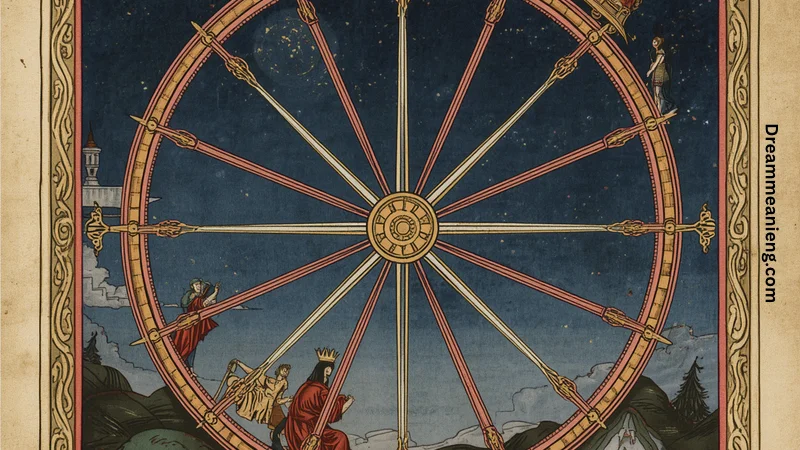
The medieval Wheel of Fortune (Rota Fortunae) shows a king at the top, a ruined figure at the bottom, and everyone else climbing or falling in between. A coaster is that same wheel, only you feel it in your stomach. Icarus adds a warning about ambition and hubris: the thrill of flight can hide how fast the fall arrives.
The ride has a history worth knowing. In French, Spanish and Italian, the roller coaster is literally called Russian mountains (montagnes russes, montaña rusa, montagne russe), a nod to the ice slides of Russia that inspired early designs. Its whole purpose was to feel dangerous while staying safe, and that is why it makes such a good dream image for managed risk.
Why Do I Keep Dreaming About Roller Coasters, and What Should I Do?
Recurring roller coaster dreams usually track an unresolved stressor, so they tend to repeat until the pressure changes or you process it.
Roller coaster dream meaning also shifts when the dream repeats, from a single mood snapshot to a signal about a pattern. Repeating coaster dreams often belong to the wider family of anxiety dreams and stress dreams, and three versions show up most often:
- Every Sunday night. The dream repeats before the work week, which often points to dread about Monday, not about coasters.
- After a loss or breakup. Grief moves in waves, and the ride repeats until the emotional swings settle.
- Ending in panic or nausea. If you wake sick or frightened each time, the stressor is likely unprocessed and worth naming.
If you want to do something with it, start small:
- Name the trigger. Ask what in waking life is moving fast right now.
- Start a dream journal. Note the dream, then answer three prompts: where do I feel carried along instead of choosing? What am I bracing for? What would make me feel steadier?
- Ground yourself before bed. Slow breathing and a steady wind down routine calm the nervous system.
- Seek support if needed. If distressing dreams disturb your sleep for several weeks, talk to a doctor or therapist.
Frequently Asked Questions
Is a roller coaster dream a warning or a prediction?
A roller coaster dream is almost never a prediction. It mirrors how you feel about change and control right now, so treat it as feedback on your stress level. If it highlights a risk you have been ignoring, use it as a prompt to review that plan.
Does a roller coaster dream mean I have anxiety?
A roller coaster dream alone does not mean you have an anxiety disorder. One dream usually reflects temporary stress or excitement. Frequent, terrifying versions that disturb your sleep for several weeks can point to ongoing anxiety, and speaking with a doctor or therapist is a sensible next step.
What does a roller coaster dream mean in Islam?
A roller coaster dream has no classical Islamic entry, because roller coasters are a modern invention, so any link to qadr (divine decree) or tawakkul (trust in God) is a modern analogy. Hadith advises seeking refuge in God from a disturbing dream (hulm), which will not harm the dreamer. Consult a qualified scholar.
What does a roller coaster dream mean in a relationship?
Roller coaster dream meaning in love usually points to emotional swings, such as an on and off pattern, unresolved feelings or fear of commitment. Riding with a partner suggests shared turbulence, while riding with an ex suggests the old pattern still shapes how you respond to closeness.
What does a roller coaster dream mean before a big life change?
People often report a roller coaster dream before weddings, moves, new jobs and births. Excitement during the ride suggests readiness, while dread suggests you need more information, rest or support before the change arrives. Pregnancy can also be a trigger, because body and routine both change quickly.
Why do I wake up feeling sick or shaken after a roller coaster dream?
Waking up shaken after a roller coaster dream is normal, because fear in a dream can raise your heart rate and trigger stress hormones as if the ride were real. Slow breathing, a glass of water and writing the dream down usually help settle the body.
How do I stop having roller coaster dreams?
You cannot switch roller coaster dreams off, but you can make them less frequent by lowering the stress behind them. Keep a regular sleep schedule, journal before bed and address the waking life pressure the dream points to. If they persist, talk to a professional.
Conclusion
A roller coaster dream is feedback about how you feel strapped into change, not a forecast of what will happen. Roller coaster dream meaning is less about the ride and more about how you felt while it carried you.
Write the dream down today, circle the strongest feeling, and match it against the tables above. Then go easy on yourself. Every ride returns to the platform eventually, and your mind is only telling you it has noticed how fast things have been moving.

Ayaan Shah is the founder of this website and a passionate dream analyst. He specializes in symbolic and psychological interpretations of dreams. With years of research in human behavior and subconscious mind, he aims to make dream meanings simple, clear, and accessible for everyone.


[…] storm dreams fall into a few patterns: overwhelm when you are caught in the storm, anticipation when you watch […]